
LifeCareBalance.com is reader-supported. When you buy through links on our site, we may earn an affiliate commission at no extra cost to you. As an Amazon Associate, we earn from qualifying purchases.
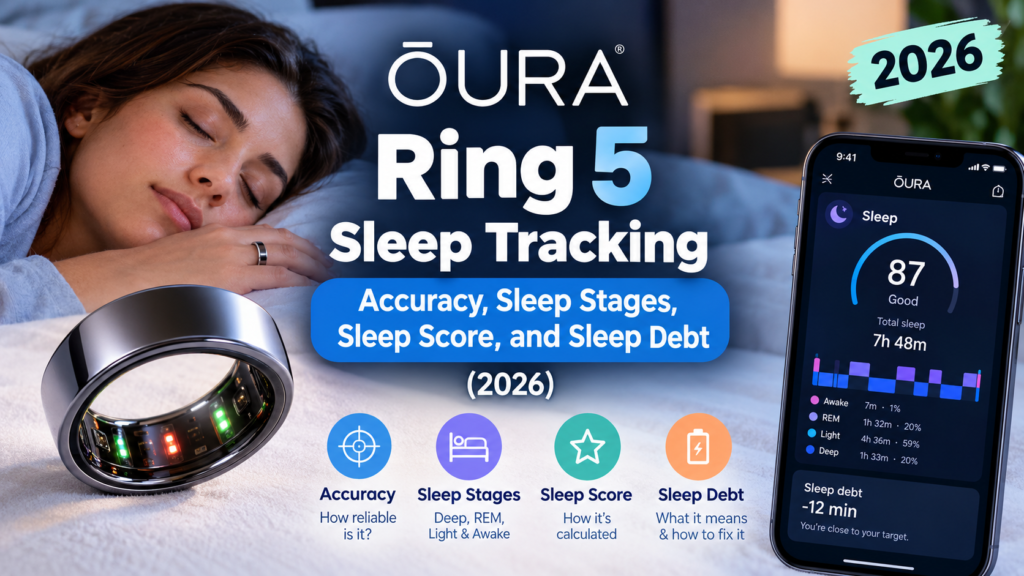
Oura Ring 5 is designed to help you understand your sleep patterns through overnight measurements collected by a smart ring. Rather than showing only how long you were in bed, the Oura app combines several signals to estimate sleep duration, sleep stages, sleep timing, restfulness, and other sleep-related patterns.
But how much should you trust those numbers?
The important distinction is that Oura Ring 5 is a consumer sleep-tracking device, not a replacement for a clinical sleep study. Its measurements can help you notice personal patterns over time, but a sleep score or estimated REM reading is not a medical diagnosis.
This guide explains how Oura Ring 5 sleep tracking works, what its sleep metrics mean, how Sleep Score and Sleep Debt are calculated, what research says about Oura’s accuracy, and how to use the information without becoming overly focused on nightly numbers.
If you want to evaluate the complete ring, including its other health and fitness features, see our Oura Ring 5 Review 2026. This article focuses specifically on sleep tracking.
Quick Answer: Is Oura Ring 5 Good for Sleep Tracking?
Oura Ring 5 is designed to estimate total sleep time, sleep timing, awake periods, light sleep, deep sleep, REM sleep, and an overall Sleep Score. Its app also offers longer-term views that can help you understand whether your sleep routine is becoming more or less consistent.
The main advantage is convenience. A ring can collect overnight data without requiring you to wear a smartwatch with a screen.
However, Oura estimates sleep stages using sensor data and proprietary algorithms rather than directly measuring brain activity as a clinical polysomnography (PSG) test does.
Research on earlier Oura generations is encouraging for several general sleep measurements, but those findings should not automatically be treated as direct validation of every Ring 5 feature.
Best use: Monitoring your own sleep patterns over time.
Not intended for: Diagnosing sleep apnea, insomnia, or another sleep disorder based on ring data alone.
How Does Oura Ring 5 Track Sleep?
Oura Ring 5 uses several sensors to collect information while you wear it overnight. According to Oura’s product documentation, the ring includes optical sensors, a temperature sensor, and an accelerometer.
These sensors collect signals that its algorithms use to estimate your sleep and related physiological patterns.
The main signals include:
- Heart rate: Changes in your heart rate can provide information about your overnight physiological patterns.
- Heart rate variability (HRV): This measures variation in the time between consecutive heartbeats and can provide context about your body’s overnight response.
- Movement: An accelerometer detects movement and periods of relative stillness.
- Temperature trends: The ring measures changes in temperature at the finger, which Oura can use as part of its broader health insights.
- Respiratory rate: Oura estimates your overnight breathing rate using physiological signals.
The ring combines these measurements rather than relying on movement alone. Its algorithms then estimate when you were asleep or awake and how your sleep was distributed among different stages.
You can review Oura’s current hardware and feature information on the official Oura Ring 5 product page.
Does Oura Measure Brain Activity?
No. Oura Ring 5 does not directly measure brain waves in the way that an electroencephalogram (EEG) does during a clinical sleep study.
Instead, it estimates sleep stages from patterns in the signals available to the ring.
This distinction matters because two devices can report similar-looking sleep graphs while using different measurement methods. A wearable estimate can be useful without being identical to a clinical measurement.
What Does Oura Ring 5 Measure During Sleep?
Oura’s sleep tools provide several metrics that describe different aspects of your night.
| Sleep metric | What it tells you |
|---|---|
| Total sleep time | Estimated time spent asleep |
| Time in bed | How long you spent in bed during the recorded sleep period |
| Sleep efficiency | The proportion of time in bed estimated to have been spent asleep |
| Sleep latency | Estimated time needed to fall asleep |
| Sleep timing | When your sleep period began and ended |
| Awake time | Estimated periods of wakefulness during the night |
| Light sleep | Estimated time in light sleep |
| Deep sleep | Estimated time in deep sleep |
| REM sleep | Estimated time in rapid eye movement sleep |
| Sleep Score | Oura’s combined assessment of sleep quality and quantity |
| Sleep Debt | Estimated shortfall compared with your personalized sleep need |
Available metrics and their presentation can change with software updates, membership features, and the data collected.
For guidance on reading the app’s sleep graphs, see Oura’s official Sleep Score documentation.
Oura Ring 5 Sleep Stages Explained
Oura displays four primary sleep states: awake, light sleep, deep sleep, and REM sleep.
The app presents estimated changes across the night in a graph commonly called a hypnogram. It can help you see when the ring detected sleep, possible awakenings, and estimated transitions between stages.
1. Awake
Awake time represents periods when the algorithm estimates that you were awake during the recorded sleep period.
Some brief awakenings are normal, and you may not remember all of them in the morning. Conversely, a wearable can sometimes misclassify periods of quiet wakefulness as sleep.
Do not assume that every awake segment indicates a problem.
2. Light Sleep
Light sleep is a normal part of the sleep cycle and commonly accounts for a substantial portion of the night.
A high light-sleep estimate does not automatically mean your sleep was poor. It should be interpreted alongside your total sleep time, regularity, how rested you feel, and your usual pattern.
3. Deep Sleep
Deep sleep is an important stage of normal sleep. Oura estimates it from patterns in the signals collected by the ring.
The estimate can vary from night to night. A single low reading does not establish that you have a sleep problem, and you should not try to force your deep-sleep percentage into a particular range based on the app alone.
4. REM Sleep
REM stands for rapid eye movement sleep. This stage is associated with dreaming and plays a role in several aspects of memory and brain function.
Oura estimates REM sleep from available physiological signals. It does not directly observe the brain activity used to classify REM during a clinical sleep study.
If your REM estimate changes considerably on one night, treat it as a signal to interpret in context rather than an exact measurement of what happened in your brain.
How Does Oura Estimate Sleep Stages?
Oura’s algorithm processes multiple signals to estimate sleep and wake states and classify sleep stages.
The general approach is different from simply counting movement. Heart rate patterns, HRV, movement, temperature-related signals, and respiratory information can contribute to the system’s interpretation.
However, Oura’s complete algorithm is proprietary. Readers should not assume that every metric has the same accuracy or that performance figures from one ring generation apply unchanged to another.
Oura has published validation information about its sleep-staging approach. When assessing such claims, it is important to check which ring generation was tested, which algorithm was used, who participated in the study, and what the researchers counted as an accurate result.
A performance figure from a particular validation study is not a guarantee that every sleep stage will be classified correctly for every user.
What Is the Oura Sleep Score?
Oura Sleep Score is a summary of sleep quality and quantity, presented on a scale from 0 to 100.
Oura says its calculation incorporates multiple contributors, including total sleep time, sleep efficiency, latency, sleep timing, restfulness, and sleep stages.
The app uses these categories:
| Sleep Score | Oura’s category |
|---|---|
| 85–100 | Optimal |
| 70–84 | Good |
| 60–69 | Fair |
| 0–59 | Pay Attention |
These are Oura’s categories, not medical classifications.
What Is a Good Oura Sleep Score?
An 85 or higher falls within Oura’s Optimal category. But a score should not be treated as a universal measure of whether your body has recovered or whether your sleep was medically healthy.
For example, imagine your typical score is in the low 80s. One night it drops into the high 60s. That change may be worth examining, particularly if you also slept less than usual or feel tired.
But the score alone cannot explain why the change happened.
Look at the contributing metrics, your recent schedule, and how you feel. A lower score is information to consider, not a diagnosis.
What Is Sleep Efficiency?
Sleep efficiency describes the proportion of your time in bed that you spent asleep.
For example, suppose you spent eight hours in bed and the ring estimated that you slept for seven hours. Your estimated sleep efficiency would be 87.5%.
The calculation is:
Sleep efficiency = total sleep time ÷ time in bed × 100
Sleep efficiency provides useful context, but it should not be interpreted in isolation. Someone can have a relatively high sleep-efficiency estimate and still need more total sleep.
What Is Sleep Latency?
Sleep latency is the estimated time between trying to sleep and falling asleep.
A longer-than-usual latency may coincide with changes in stress, caffeine intake, travel, bedtime, or your sleeping environment. It does not establish the cause of the change.
Use this metric to identify recurring patterns rather than judging an isolated night.
If difficulty falling asleep persists and affects your daytime functioning, consider discussing it with a healthcare professional instead of relying solely on wearable data.
What Is Oura Sleep Debt?
Sleep Debt estimates how much sleep you may have missed compared with your personalized sleep need over the previous two weeks.
According to Oura’s documentation, the feature compares recorded sleep with its estimate of your personal sleep need and gives more weight to recent days. Oura says at least five nights of sleep data within the previous 14 days are needed to calculate Sleep Debt.
The feature is intended to show a pattern that may be difficult to recognize by looking at only the previous night.
For example, if you regularly sleep less than your usual need during a busy workweek, your estimated Sleep Debt may build. That can prompt you to review your schedule and consider making more time for sleep.
However, Sleep Debt remains an estimate based on the ring’s recorded data and Oura’s calculation method. It is not a direct measurement of a biological debt inside your body.
For the latest details on availability and calculations, consult Oura’s Sleep Debt documentation.
How Does Oura Estimate Your Personal Sleep Need?
Oura’s Sleep Debt documentation explains that its personalized sleep-need estimate uses typical sleep patterns over the previous 90 days and filters unusually short or long nights when establishing a baseline.
This provides a reference based partly on your own history instead of assuming every adult needs exactly the same amount of sleep.
Nevertheless, an algorithmic baseline is not a substitute for general sleep guidance or professional advice when symptoms persist. Your sleep needs can vary with age, routine, activity, and individual circumstances.
If you recently started wearing the ring or have inconsistent overnight data, give the system time to collect enough information before drawing conclusions from its longer-term estimates.
How Accurate Is Oura Ring 5 Sleep Tracking?
Accuracy needs to be considered separately for different measurements.
Estimating total sleep time is not the same task as classifying every minute as light, deep, or REM sleep. A device may estimate overall sleep duration reasonably well while still making mistakes about individual stages or brief awakenings.
A systematic review and meta-analysis published in 2025 examined six studies involving 388 participants and compared Oura measurements with polysomnography or actigraphy. The researchers did not find statistically significant average differences for several outcomes, including total sleep time, sleep efficiency, wake after sleep onset, sleep-onset latency, and estimated sleep-stage durations.
You can read the paper through PubMed’s published research record.
These findings are encouraging for self-monitoring, but they require careful interpretation.
First, the review included studies of Oura rings rather than establishing that every feature of Oura Ring 5 has been independently validated. Second, a finding of no statistically significant average difference does not mean every individual’s readings match a clinical test. Third, results across a group do not guarantee the same performance in every person or situation.
What About Older Oura Ring Studies?
Some frequently cited Oura validation research evaluated earlier generations, including Gen3 with its sleep-staging algorithm.
Those studies can provide useful background about Oura’s general approach, but they should not be presented as direct clinical validation of Ring 5 unless the researchers actually tested Ring 5.
Hardware, sensors, software, algorithms, study participants, and testing methods all matter when interpreting an accuracy claim.
What Does Independent Sleep Research Tell Us?
The American Academy of Sleep Medicine has emphasized that consumer sleep technologies can support awareness and conversations with healthcare professionals, but they should not be relied on alone to diagnose or treat sleep disorders.
The broader lesson is that sleep wearables are most useful when their capabilities and limitations are understood. Read the AASM position statement on consumer sleep technology for further context.
Bottom line on accuracy: Oura can help you monitor sleep estimates and personal trends. It cannot guarantee that every sleep stage, awakening, or score reflects your exact physiological state.
Oura Ring 5 vs. a Clinical Sleep Study
A clinical polysomnography test uses multiple measurements to assess sleep. Depending on the test, these can include brain activity, eye movements, muscle activity, heart activity, breathing, and blood oxygen.
Oura Ring 5 does not directly measure all the signals collected in a full PSG study. Instead, it uses the signals available from the ring and algorithms to estimate sleep patterns.
| Feature | Oura Ring 5 | Clinical polysomnography |
|---|---|---|
| Main purpose | Personal sleep monitoring | Clinical sleep evaluation |
| Brain activity measured directly | No | Yes |
| Sleep stages | Algorithmic estimates | Classified using clinical measurements |
| Repeated home tracking | Designed for ongoing personal use | Depends on the prescribed test |
| Diagnoses sleep disorders by itself | No | Can support diagnosis when clinically interpreted |
A ring can be convenient for tracking your routine over weeks or months. A clinical sleep study is appropriate when a healthcare professional needs more detailed information to investigate a suspected sleep disorder.
Can Oura Ring 5 Detect Sleep Apnea?
Oura’s current product information includes nighttime breathing features that can highlight patterns of possible breathing disturbances. Such information should not be treated as a confirmed diagnosis of sleep apnea.
A consumer wearable’s breathing-related indicators are not equivalent to a clinical assessment of sleep apnea severity.
If you regularly experience loud snoring, gasping during sleep, witnessed pauses in breathing, or significant daytime sleepiness, seek professional evaluation. Do not use a reassuring ring score as proof that everything is fine, and do not use an unusual score as proof that you have a disorder.
How to Use Oura Sleep Data More Effectively
1. Look at Trends Instead of One Night
A single night’s data can be affected by unusual schedules, travel, interruptions, sensor fit, and other factors.
Review your sleep across multiple days or weeks to see whether a change is persistent.
2. Establish Your Personal Baseline
People have different routines and sleep patterns. Your own history may be more useful than comparing your Sleep Score or REM estimate with someone else’s.
Use the baseline as a reference, not as a target that must be met every night.
3. Pay Attention to Sleep Duration and Timing
Consider whether you consistently allow enough time for sleep and whether your bedtime and wake-up times vary substantially.
The ring can help you notice these patterns, but the practical response is often to review your routine rather than chase a particular stage percentage.
4. Compare the Data With How You Feel
Wearable data is only one source of information.
If the ring reports a good night but you feel exhausted, pay attention to that difference. Similarly, a lower score does not automatically mean something is medically wrong.
5. Avoid Chasing Perfect Sleep Stages
Trying to maximize deep sleep or REM every night can make ordinary variation feel like a problem.
Sleep-stage estimates are not exact laboratory measurements. Focus on consistent habits, sufficient sleep opportunity, and meaningful changes rather than trying to produce a perfect graph.
6. Record Possible Influences Without Assuming Cause
You might notice changes after travel, late meals, alcohol, caffeine, stressful days, or hard workouts. These observations can help you form questions about your routine.
However, a pattern in the app does not prove that one particular habit caused the change. Consider repeated observations and other explanations.
Common Oura Sleep-Tracking Mistakes to Avoid
Treating Sleep Score as a medical result: The score summarizes Oura’s estimates; it does not diagnose your health.
Assuming every awakening is accurate: Quiet wakefulness and brief interruptions may be misclassified.
Comparing yourself with another user: Individual sleep needs and routines differ.
Applying older-generation research directly to Ring 5: Always check which hardware and algorithm were tested.
Ignoring persistent symptoms because the score looks good: Symptoms and clinical assessment matter more than a consumer score when a sleep disorder is suspected.
Making major health decisions from one reading: Look for repeated patterns and seek professional advice when needed.
Oura Ring 5 Sleep Tracking: Who Is It Best For?
Oura’s sleep tools may be useful for people who want to:
- Monitor estimated sleep duration over time.
- Review sleep timing and routine consistency.
- See estimated changes in light, deep, and REM sleep.
- Understand how Sleep Score varies from their baseline.
- Follow the app’s Sleep Debt estimate.
- Compare sleep patterns with daily habits and subjective restfulness.
It is less suitable for someone who expects a consumer ring to provide definitive clinical sleep-stage measurements or diagnose a sleep disorder.
If you’re comparing wearable options rather than evaluating sleep tracking alone, our Oura Ring 5 vs. Samsung Galaxy Ring comparison examines that separate buying decision.
For a broader look at Oura’s earlier product generation, see our Oura Ring 4 review.
Frequently Asked Questions
Does Oura Ring 5 track REM sleep?
Yes. Oura estimates REM sleep and displays it alongside light sleep, deep sleep, and awake periods in the app.
Does Oura Ring 5 track deep sleep?
Yes. Deep sleep is one of the estimated sleep stages. The ring does not directly measure the brain waves used in clinical sleep staging.
Is Oura Ring 5 sleep tracking accurate?
Oura research suggests that its rings can provide useful estimates for several sleep measurements. However, performance varies by metric and study, and research on earlier generations should not automatically be treated as direct validation of Ring 5.
What is a good Oura Sleep Score?
Oura categorizes scores of 85–100 as Optimal, 70–84 as Good, 60–69 as Fair, and 0–59 as Pay Attention. These categories are not medical diagnoses.
What is Oura Sleep Debt?
Sleep Debt estimates the amount of sleep you may have missed compared with your personalized sleep need over the previous two weeks. Oura requires at least five nights of sleep data within the previous 14 days for this feature.
Can Oura Ring 5 diagnose sleep apnea?
No. Ring data should not be used alone to diagnose sleep apnea or determine its severity. Suspected sleep disorders require appropriate clinical evaluation.
Should I trust Oura’s REM and deep-sleep numbers?
Use them as estimates that may help you observe personal trends. Do not assume they are exact measurements of your physiological sleep stages.
Is Oura Ring 5 a replacement for a sleep study?
No. A clinical sleep study measures physiological signals that a consumer ring does not directly measure and may be needed when a sleep disorder is suspected.
Final Verdict: Is Oura Ring 5 Worth Using for Sleep Tracking?
Oura Ring 5 is best understood as a personal sleep-monitoring tool. Its combination of overnight measurements, estimated sleep stages, Sleep Score, and longer-term trends can help users understand their routines without wearing a screen-based device to bed.
Its main value is the ability to observe patterns over time—not to provide a perfect measurement of every sleep stage or a medical explanation for every unusual night.
Research on Oura rings supports their potential usefulness for several sleep measurements, but findings must be interpreted according to the generation and methods actually studied. Ring 5-specific marketing claims should not be confused with independent validation of every feature.
For the most practical results, focus on your sleep duration, schedule, longer-term trends, and how you feel during the day. Use the ring’s data as context, not as a diagnosis. If persistent symptoms suggest a sleep disorder, consult a qualified healthcare professional rather than relying on a wearable score alone.