
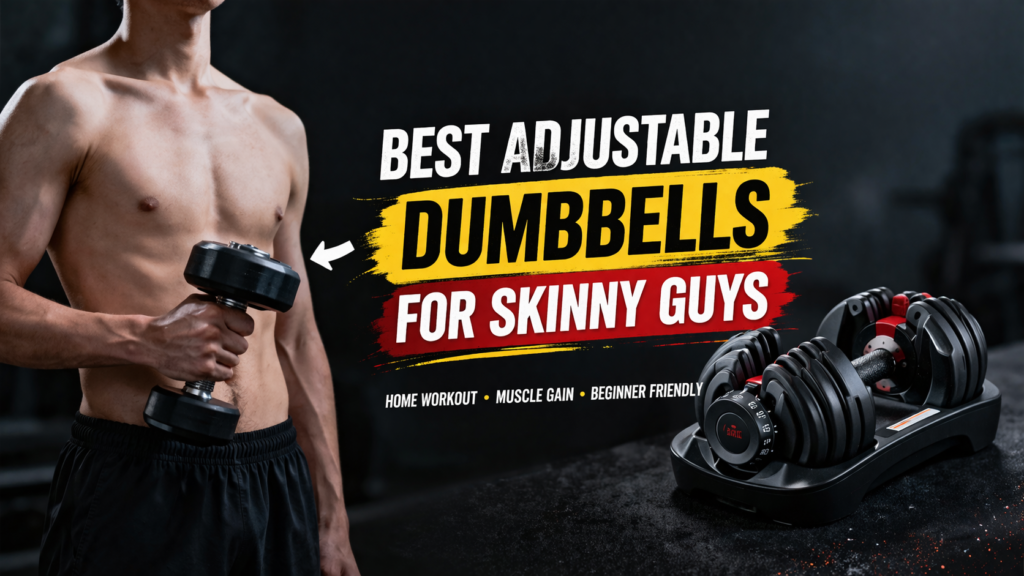
Build muscle at home with adjustable dumbbells. Learn the right weight range, exercises, progressive overload, protein, nutrition, safety, and 2026 buying tips.
LifeCareBalance.com is reader-supported. When you buy through links on our site, we may earn an affiliate commission at no extra cost to you. As an Amazon Associate, we earn from qualifying purchases.
If you are naturally skinny, have a small frame, or struggle to gain body weight, building muscle can feel frustrating. You may work out consistently, eat more, and still feel like your progress is slower than everyone else’s.
The good news is that you do not need a commercial gym or a room full of expensive machines to start building a stronger, more muscular body.
A well-designed home strength program, adequate nutrition, recovery, and the right adjustable dumbbells can give you a practical foundation for gaining muscle.
The key is understanding that adjustable dumbbells are a training tool—not a shortcut.
Your results come from how you use them.
You need enough resistance to challenge your muscles, a progression strategy that becomes harder over time, enough protein and total calories to support your goal, and enough recovery between workouts.
This guide is specifically designed for skinny beginners and naturally slim people who want to build muscle at home with adjustable dumbbells.
If you are looking for a general comparison of adjustable dumbbells rather than a muscle-building guide, see our [Best Adjustable Dumbbells for Home Gyms in 2026]. Best Adjustable Dumbbells for Home Gyms in 2026
Can Skinny Guys Build Muscle at Home?
Absolutely.
Being naturally slim does not mean that you cannot gain muscle. Your starting body size can influence how your progress looks, but resistance training, nutrition, recovery, genetics, training history, and consistency all contribute to the outcome.
The American College of Sports Medicine’s 2026 resistance-training update reviewed 137 systematic reviews representing more than 30,000 participants. Its guidance emphasizes that consistency matters more than complicated training programs and that resistance training can improve muscle size and strength.
That is important for skinny beginners because it removes one common misconception:
You do not need an advanced gym setup to start.
You need a training system that you can use consistently and progressively.
Adjustable dumbbells are particularly useful because they allow you to train multiple muscle groups while taking up far less space than a complete rack of fixed dumbbells.
Why Adjustable Dumbbells Are So Useful for Skinny Beginners
A skinny beginner usually needs two things from home-training equipment:
- Enough resistance to create a meaningful training stimulus.
- Enough flexibility to increase resistance as strength improves.
Adjustable dumbbells can provide both.
1. They Allow Progressive Resistance
Your first workouts should not be about lifting the heaviest weight possible.
Instead, you want to establish good movement patterns and gradually make your training more demanding.
With adjustable dumbbells, you can start lighter and increase the resistance as your strength improves.
That progression may happen through:
- More repetitions
- More sets
- Better exercise technique
- Greater range of motion
- Slower controlled repetitions
- Increased dumbbell weight
You do not have to add weight every workout.
The goal is to make your training progressively more challenging over time.
2. They Save a Huge Amount of Space
A traditional dumbbell rack may require dozens of separate pairs.
For someone living in an apartment, bedroom, small home, or compact garage gym, that is not practical.
One adjustable system can replace multiple fixed-weight dumbbells.
This is particularly useful if your workout area needs to serve multiple purposes.
For another look at compact equipment, see our [Affordable Adjustable Dumbbells for Small Spaces]. Affordable Adjustable Dumbbells for Small Spaces
3. One Pair Can Train Your Entire Body
You can use adjustable dumbbells for:
- Chest presses
- Rows
- Shoulder presses
- Romanian deadlifts
- Goblet squats
- Split squats
- Lunges
- Curls
- Triceps extensions
- Lateral raises
- Carries
That makes them one of the most versatile pieces of equipment for a small home gym.
What Weight Should a Skinny Beginner Start With?
There is no single starting weight that is correct for everyone.
Your ideal dumbbell weight depends on the exercise, your current strength, training history, and ability to maintain good technique.
For example, the weight you can use for a goblet squat may be considerably heavier than the weight you can control during a lateral raise.
That is normal.
Instead of asking:
“What weight should a skinny guy lift?”
ask:
“What weight allows me to perform this exercise with good technique while making the set challenging?”
That is a much more useful question.
For many beginners, having access to a range that starts around 5 pounds per dumbbell and progresses toward 40–50 pounds or more can provide plenty of room to learn and progress.
If you become substantially stronger, an expandable system may make more sense.
What to Look for When Buying Adjustable Dumbbells
Not every adjustable dumbbell is equally useful for muscle building.
Before buying, look at these features.
1. Starting Weight
The dumbbell should be light enough for exercises that require less resistance.
This matters particularly for:
- Lateral raises
- Curls
- Triceps work
- Some shoulder exercises
- Warm-up sets
A system that starts too heavy may force you to compromise your technique.
2. Maximum Weight
Think about where you want to be—not just where you are today.
A beginner may be perfectly comfortable with 20–30 pounds per hand at first.
Several months or years later, that same resistance may be inadequate for movements such as rows, split squats, Romanian deadlifts, and presses.
If you plan to train long term, an expandable system can reduce the chance that you will need to replace your equipment later.
3. Small Weight Increments
Small increases are useful for progressive overload.
A jump from 20 to 22.5 pounds may be manageable on one exercise, while jumping from 20 to 25 pounds could be too large for another.
This is why weight increments matter almost as much as the maximum weight.
4. Adjustment Mechanism
Common systems include:
- Dial adjustment
- Selector pins
- Twist-lock handles
- Plate-loaded systems
- Locking collars
A fast adjustment system is convenient if you regularly switch between exercises.
A plate-loaded system may be slower but can provide a more traditional free-weight experience.
5. Handle Comfort
You may eventually perform hundreds of repetitions every week.
A handle that feels uncomfortable or unstable can become a genuine annoyance.
Look for:
- Secure grip
- Appropriate handle diameter
- Good balance
- Minimal unwanted movement
- Comfortable texture
6. Safety and Locking
This is especially important with adjustable equipment.
Before every set, confirm that the selected weight is properly engaged.
Do not assume that because a dumbbell looks assembled, every plate is locked correctly.
The CPSC recalled certain Amazon Basics 55-pound adjustable dumbbells in May 2026 after reports that weight plates could fail to engage completely and dislodge during use.
That does not mean adjustable dumbbells are inherently unsafe. It means the adjustment and locking system deserves serious attention when you buy and use them.
Best Adjustable Dumbbells for Skinny Guys
Rather than simply copying a generic “Top 10” list, these options represent different approaches to home muscle training.
1. PowerBlock Elite EXP
Best for: Long-term progression and expandable training
The PowerBlock Elite EXP is particularly interesting for someone who starts as a beginner but expects to keep strength training for years.
The system uses a selector pin and can be expanded substantially as your strength increases. PowerBlock currently lists the Elite EXP as expandable up to approximately 40.8 kg per hand with all expansion kits, with lighter starting configurations available.
PowerBlock Elite EXP Official Product Page
Why it stands out
- Expandable design
- Compact footprint
- Quick weight changes
- Micro-weight options
- Strong long-term progression potential
Potential drawback
The block-style design does not feel exactly like a traditional dumbbell.
For some exercises, that shape may take a short adjustment period.
2. Core Home Fitness Adjustable Dumbbells
Best for: Beginners who want fast, simple adjustments
Core Home Fitness currently offers adjustable dumbbells that move from 5 to 50 pounds per dumbbell in 5-pound increments.
The company uses a Twist-Lock system designed to change resistance while the dumbbell is seated in its cradle.
Core Home Fitness Adjustable Dumbbells
Why it stands out
- 5–50 lb range per dumbbell
- Quick adjustment
- Compact design
- Comfortable handle
- Suitable for full-body home workouts
Potential drawback
Five-pound jumps can become limiting for certain isolation exercises where smaller increases would be useful.
3. Ironmaster Quick-Lock Adjustable Dumbbells
Best for: Serious long-term strength training
Ironmaster takes a more traditional approach.
Its Quick-Lock system can be adjusted from 5 to 75 pounds per dumbbell in 2.5-pound increments in the 75-pound set, according to the manufacturer. The company also offers expansion options beyond that range.
Ironmaster Quick-Lock Adjustable Dumbbells
Why it stands out
- 2.5-lb progression
- Heavy-duty construction
- Traditional dumbbell feel
- Expandable system
- Suitable for long-term strength development
Potential drawback
It takes longer to change weight than a dial or selector-pin system.
What About BowFlex SelectTech 552?
The BowFlex SelectTech 552 is a familiar name in adjustable dumbbells, but 2026 buyers need to understand the product history before purchasing.
Certain older BowFlex 552 and 1090 adjustable dumbbells were recalled in 2025 because weight plates could detach from the handle during use. LifeCareBalance already has a dedicated [BowFlex SelectTech 552 Review for 2026] that discusses the recall, product versions, specifications, and buying considerations. BowFlex SelectTech 552 Review 2026
If you are considering a used unit, verify the exact model and recall information before using it.
Do not assume that every current BowFlex product is automatically part of the older recall.
Adjustable Dumbbells vs. Fixed Dumbbells for Skinny Beginners
Both types can support muscle-building workouts.
The difference is mainly in convenience, storage, and how quickly you can change resistance.
| Feature | Adjustable Dumbbells | Fixed Dumbbells |
|---|---|---|
| Space | Very efficient | Requires more space |
| Weight changes | Manual adjustment | Instant |
| Number of weights | Multiple settings in one system | Separate pair for each weight |
| Storage | Compact | Larger footprint |
| Long-term progression | Depends on maximum range | Requires buying additional pairs |
| Home-gym convenience | High | High if space is available |
| Traditional feel | Depends on design | Yes |
If you have limited space, adjustable dumbbells can simplify your setup considerably.
For a broader beginner comparison, see our [Best Adjustable Dumbbells for Beginners in 2026]. Best Adjustable Dumbbells for Beginners in 2026
The Best Dumbbell Exercises for Skinny Guys
The goal is not to perform 30 different exercises.
A small number of well-selected movements can cover your entire body.
Chest
Dumbbell Floor Press
A floor press is an excellent option if you do not own a bench.
It trains the chest, shoulders, and triceps while requiring very little equipment.
Dumbbell Bench Press
If you have a stable bench, the dumbbell bench press gives you another useful pressing movement.
Back
One-Arm Dumbbell Row
The one-arm row is one of the most useful dumbbell exercises for home training.
It allows you to train each side independently while using a relatively heavy resistance.
Dumbbell Romanian Deadlift
The Romanian deadlift emphasizes the posterior chain, including the hamstrings and glutes.
Keep the movement controlled and focus on a proper hip hinge rather than simply lowering the dumbbells as far as possible.
Shoulders
Dumbbell Shoulder Press
This movement trains the shoulders and triceps while requiring only a pair of dumbbells.
Lateral Raise
Lateral raises generally require much less weight.
Do not chase heavy numbers.
Use controlled repetitions and avoid swinging the dumbbells.
Legs
Goblet Squat
The goblet squat is beginner-friendly and easy to perform with one dumbbell.
Bulgarian Split Squat
This unilateral movement can become challenging even when the dumbbells are not extremely heavy.
Dumbbell Romanian Deadlift
Use a controlled hip hinge and gradually increase resistance as your technique improves.
Arms
Dumbbell Curl
Use a controlled movement instead of swinging the weight.
Overhead Triceps Extension
This can be performed with one dumbbell held using both hands or with a suitable single-arm variation.
A Better 3-Day Dumbbell Workout for Skinny Beginners
A common mistake is making a beginner program unnecessarily complicated.
You can start with three full-body sessions per week.
ACSM’s 2026 resistance-training guidance emphasizes consistency and suggests training all major muscle groups at least twice per week as a useful general framework. For hypertrophy, its updated guidance highlights the importance of adequate weekly training volume.
Monday — Full Body A
Goblet Squat
3 sets × 8–12 reps
Dumbbell Floor Press
3 sets × 8–12 reps
One-Arm Dumbbell Row
3 sets × 8–12 reps per side
Romanian Deadlift
2 sets × 8–12 reps
Dumbbell Curl
2 sets × 10–15 reps
Lateral Raise
2 sets × 10–15 reps
Wednesday — Full Body B
Bulgarian Split Squat
3 sets × 8–12 reps per leg
Dumbbell Shoulder Press
3 sets × 8–12 reps
One-Arm Dumbbell Row
3 sets × 8–12 reps
Dumbbell Romanian Deadlift
3 sets × 8–12 reps
Overhead Triceps Extension
2 sets × 10–15 reps
Dumbbell Curl
2 sets × 10–15 reps
Friday — Full Body A
Repeat Monday’s workout.
The following week, you can switch the order and perform B/A/B.
This gives you a simple structure without requiring seven different workout days.
How to Progress When the Dumbbells Start Feeling Easy
This is where many beginners make a mistake.
They either increase the weight too quickly or stay at exactly the same resistance for months.
Instead, use a simple progression method.
Suppose your target range is 8–12 repetitions.
You start with:
20 lb × 8 reps
Over several workouts you might reach:
20 lb × 10 reps
Then:
20 lb × 12 reps
If you can complete the upper end of your planned range with good technique, consider moving to the next appropriate weight.
You might then return to:
22.5 lb × 8 reps
That creates a measurable progression.
The exact method can vary by exercise.
How Much Training Volume Do You Need?
More is not automatically better.
ACSM’s 2026 position stand highlights approximately 10 weekly sets per muscle group as a useful hypertrophy-oriented reference point, while also emphasizing that the program should be individualized.
For a beginner, you do not necessarily need to jump immediately into high-volume training.
Start with a manageable workload.
Then increase your training volume gradually as your recovery and experience improve.
Your body should be able to recover between sessions.
Nutrition for Skinny Guys Trying to Build Muscle
This is where the article becomes different from a normal dumbbell buying guide.
The dumbbells create the training stimulus.
Your diet supports the process.
If you consistently eat too little, gaining body weight can be difficult even if your workouts are well structured.
That does not mean you need to eat unlimited junk food.
Instead, build meals around:
- Protein-rich foods
- Carbohydrates
- Healthy fats
- Fruits
- Vegetables
- Dairy or suitable alternatives
- Adequate fluids
For more personalized nutrition guidance, see our [Personalized Nutrition and Health] guide. Personalized Nutrition and Health
How Much Protein Do You Need?
Protein needs vary based on body size, training status, age, total calorie intake, and goals.
The International Society of Sports Nutrition’s position stand states that 1.4–2.0 grams of protein per kilogram of body weight per day is sufficient for most exercising individuals.
Research has also found that around 1.6 g/kg/day is a useful reference point for maximizing many resistance-training adaptations in healthy adults.
For example, someone weighing 150 pounds (about 68 kg) could use 1.6 g/kg as a rough reference:
68 × 1.6 = approximately 109 grams of protein per day
This is an example—not a prescription.
Individual needs can differ.
Good food sources include:
- Eggs
- Chicken
- Fish
- Lean beef
- Greek yogurt
- Milk
- Cottage cheese
- Beans
- Lentils
- Tofu
- Nuts and seeds
Protein powder can be convenient, but it is not mandatory.
Do Skinny Guys Need a Calorie Surplus?
If your goal is to gain body weight and muscle, you need enough total energy to support that goal.
A modest calorie surplus can make weight gain easier, but there is no reason to force extremely rapid weight gain.
Monitor your progress over several weeks.
Useful measurements include:
- Body weight
- Waist measurement
- Training performance
- Exercise repetitions
- Dumbbell resistance
- Progress photos
If your weight remains unchanged for a sustained period despite trying to gain, your total food intake may need adjustment.
If you have unexplained difficulty gaining weight or other health symptoms, speak with a qualified healthcare professional instead of assuming that being “naturally skinny” explains everything.
What Should a Skinny Beginner Eat?
A practical muscle-building meal might include:
Breakfast
Eggs + oatmeal + fruit + milk
Lunch
Chicken + rice + vegetables + olive oil
Snack
Greek yogurt + fruit + nuts
Dinner
Lean beef or fish + potatoes or rice + vegetables
Evening Snack
Milk or Greek yogurt + peanut butter toast
You do not need a complicated bodybuilding diet.
You need enough food, enough protein, and a routine you can maintain.
Supplements: Do You Need Them?
No supplement can replace consistent resistance training and adequate nutrition.
Protein powder can help if you struggle to reach your daily protein target through food.
Creatine is another supplement commonly used in resistance-training contexts, but supplementation should be considered separately from the basic equipment question.
For this article, the priority remains:
Training → Food → Protein → Recovery → Consistency
Supplements are optional additions, not the foundation.
Recovery Is Part of Muscle Building
Muscle-building does not happen only while you are lifting.
Recovery matters too.
Your routine should include:
- Adequate sleep
- Rest days
- Sufficient food
- Enough protein
- Manageable training volume
- Consistent hydration
If you train hard every day without allowing recovery, adding more workouts may not improve your results.
A complete wellness routine should also support your sleep and daily habits. Our [Healthy Lifestyle & Daily Wellness Guide] covers broader habits that can complement a structured fitness routine. Healthy Lifestyle & Daily Wellness Guide
Common Mistakes Skinny Beginners Make
Mistake 1: Trying to Lift Heavy Immediately
Your first goal is not to impress anyone.
Learn the movement.
Then build strength.
Mistake 2: Only Training Your Arms
Curls and triceps extensions have their place.
But a complete muscle-building program should train:
- Legs
- Back
- Chest
- Shoulders
- Arms
- Core
Mistake 3: Changing Programs Constantly
Give a training program enough time to produce measurable progress.
Constantly switching exercises makes it difficult to know whether you are actually getting stronger.
Mistake 4: Not Eating Enough
If you are naturally slim and trying to gain weight, consistently under-eating can work against your goal.
Mistake 5: Using Momentum Instead of Muscle
If your entire body is moving during a curl, the dumbbell may simply be too heavy.
Reduce the weight and regain control.
Mistake 6: Ignoring the Adjustment Mechanism
Never rush through weight changes.
Make sure the selected plates or mechanism are fully engaged before lifting.
Mistake 7: Expecting a Transformation in a Few Weeks
Muscle gain is a long-term process.
There is no universal number of weeks when every person will suddenly look muscular.
Track your training and nutrition instead of chasing unrealistic deadlines.
Are Adjustable Dumbbells Safe?
They can be safe when used correctly and maintained according to the manufacturer’s instructions.
But adjustable dumbbells contain moving or locking components, so users need to pay attention to the mechanism.
Before every workout:
- Check the selected weight
- Confirm plates are properly engaged
- Inspect the handle
- Check for damaged parts
- Follow manufacturer instructions
- Place the dumbbells down under control
- Do not use equipment that appears damaged
CPSC’s May 2026 Amazon Basics recall demonstrates why buyers should also check current product-safety information before purchasing adjustable dumbbells.
You can also check the [CPSC Recalls Database] for current product safety notices. CPSC Recalls Database
Do You Need a Bench?
Not necessarily.
You can perform a large number of effective exercises on the floor or while standing.
A bench becomes useful when you want additional pressing and supported exercise variations.
If your budget is limited, adjustable dumbbells should not automatically be accompanied by a large equipment purchase.
Start with the basics.
Add equipment only when it solves a real training limitation.
Can You Build a Home Gym Around Adjustable Dumbbells?
Yes.
A minimalist setup could include:
Essential
- Adjustable dumbbells
- Exercise mat
- Open floor space
Useful Upgrade
- Stable adjustable bench
- Resistance bands
- Storage stand
Optional Later
- Pull-up equipment
- Additional resistance equipment
- Cardio equipment
- Recovery tools
LifeCareBalance’s [Fitness and Movement Products Guide for 2026] covers how different types of home fitness equipment fit different training goals. Fitness and Movement Products: The Best Gear for a Smarter Home Workout in 2026
What About Resistance Bands?
Resistance bands can complement adjustable dumbbells.
They are especially useful for:
- Travel
- Warm-ups
- Mobility work
- Additional resistance exercises
- Small spaces
If you want another compact training option, see our [Resistance Bands Set with Handles and Door Anchor] guide. Resistance Bands Set with Handles and Door Anchor
You do not need to choose one or the other.
Dumbbells can provide progressive external loading while bands can add variety.
The Smartest Way to Choose Your Dumbbells
Before purchasing, answer five questions.
Question 1: How strong am I today?
Choose a system that starts low enough for your weakest exercises.
Question 2: How strong do I expect to become?
If you intend to train for years, consider expandable equipment.
Question 3: How much space do I have?
Measure your actual workout area.
Question 4: How quickly do I need to change weights?
If you perform circuits or supersets, fast adjustment can be valuable.
Question 5: How much do small weight jumps matter?
If progressive overload is a major priority, smaller increments can make your training easier to fine-tune.
Our 2026 Buying Checklist
Before clicking Buy, check:
Weight range: Does it start light enough and go heavy enough?
Increments: Can you make manageable increases?
Adjustment system: Is it quick enough for your workout style?
Grip: Can you comfortably hold it during longer sessions?
Length: Does the dumbbell become awkward at higher weights?
Safety: Does the locking system feel secure?
Durability: Is the construction appropriate for regular use?
Expansion: Can you increase the maximum weight later?
Storage: Does it fit your available space?
Warranty: What happens if something fails?
Recall status: Has the exact model been checked against current safety notices?
This checklist is more useful than simply choosing the dumbbell with the highest advertised maximum weight.
Final Verdict: What Skinny Beginners Should Actually Buy
If you are skinny, new to resistance training, and want to build muscle at home, do not choose adjustable dumbbells simply because they are popular.
Choose them based on your current strength, expected progression, available space, adjustment system, and long-term training plan.
For a beginner who wants a compact system with room to grow, PowerBlock Elite EXP offers an expandable approach.
For someone who prioritizes fast adjustments and a conventional home-gym setup, Core Home Fitness is another option.
For someone who wants a heavier, traditional-feeling adjustable system with smaller weight increments, Ironmaster Quick-Lock is worth examining.
There is no requirement to buy the most expensive option.
The most important purchase is the one you will use consistently and safely.
And remember:
The dumbbells do not build the muscle by themselves.
Your training creates the stimulus.
Your nutrition supports the process.
Your recovery allows you to adapt.
Your consistency turns those pieces into progress.
That is what makes a simple pair of adjustable dumbbells potentially powerful for someone who wants to build a stronger body at home.
Frequently Asked Questions
Are adjustable dumbbells good for skinny guys?
Yes. Adjustable dumbbells can provide the resistance needed for a structured muscle-building program while taking up much less space than a complete rack of fixed weights.
What weight should a skinny beginner start with?
Start with a weight that allows controlled repetitions and good technique while still making the final repetitions challenging. Your appropriate weight will vary by exercise.
Can skinny guys build muscle with dumbbells at home?
Yes. Consistent resistance training can improve muscle size and strength, and home-based training can be effective when the program is performed consistently and progressed appropriately.
How many days per week should a skinny beginner train?
Three full-body resistance sessions per week can provide a practical starting structure. Your exact schedule should allow adequate recovery.
Are 50-pound adjustable dumbbells enough?
They can provide substantial training capacity for many beginners and intermediate home lifters. Whether 50 pounds remains sufficient long term depends on the individual’s strength and exercise selection.
Should I buy PowerBlock or Ironmaster?
The better fit depends on what you prioritize. PowerBlock emphasizes quick selector-pin adjustment and expansion, while Ironmaster uses a more traditional plate-and-locking-screw design with smaller increments.
Do I need a bench to build muscle at home?
No. You can perform many productive exercises using only dumbbells and floor space. A bench simply expands your exercise options.
How much protein should I eat when building muscle?
A commonly cited evidence-based range for exercising individuals is approximately 1.4–2.0 grams of protein per kilogram of body weight per day. Individual needs vary.
Do I need protein powder?
No. Protein powder is optional and can simply make it easier to reach your daily protein target.
Should I gain weight quickly if I am skinny?
Rapid weight gain is not necessary. A controlled approach with adequate food, protein, resistance training, and monitoring is generally more practical than trying to gain as quickly as possible.
Are adjustable dumbbells safe?
They can be when used correctly. Always confirm that the adjustment mechanism is fully engaged and follow the manufacturer’s instructions. Also check current product recalls before buying used equipment.
What is the biggest mistake skinny beginners make?
Trying to solve everything with heavier weights.
Building muscle requires a combination of progressive training, sufficient nutrition, protein, recovery, and consistency.
Related LifeCareBalance Guides
For readers who want to build a complete home muscle-building and wellness routine:
- [Best Adjustable Dumbbells for Home Gyms in 2026] Open LifeCareBalance Adjustable Dumbbell Guide
- [Best Adjustable Dumbbells for Beginners in 2026] Open Beginner Adjustable Dumbbell Guide
- [Affordable Adjustable Dumbbells for Small Spaces] Open Small-Space Dumbbell Guide
- [Fitness and Movement Products for 2026] Open Fitness & Movement Guide
- [Personalized Nutrition and Health] Open Personalized Nutrition Guide
- [Healthy Lifestyle & Daily Wellness Guide] Open Healthy Lifestyle Guide