
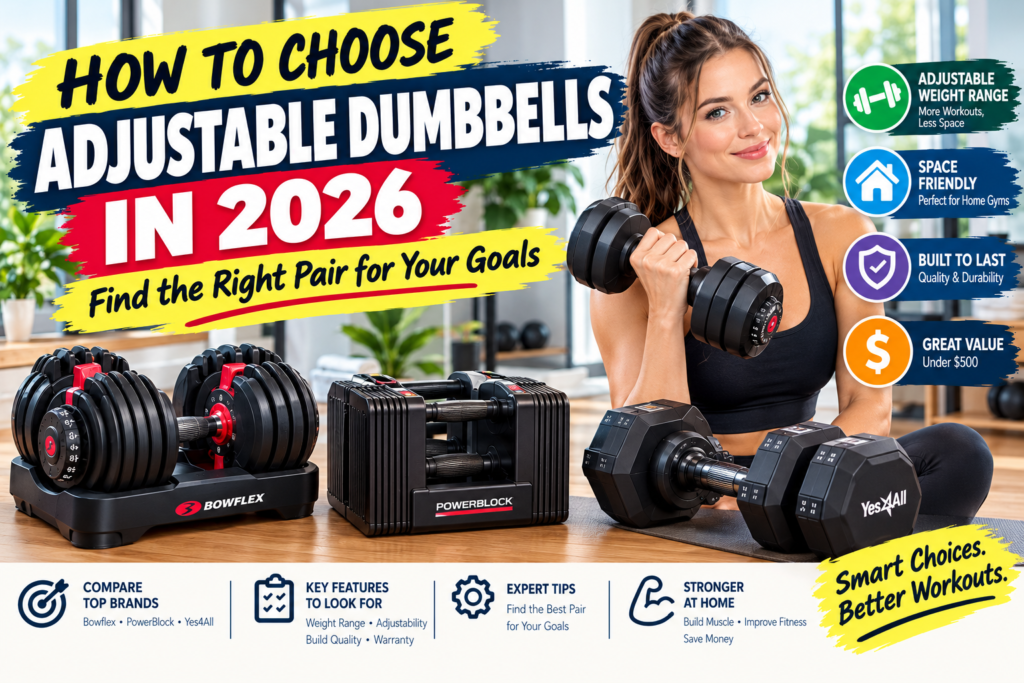
Learn how to choose adjustable dumbbells in 2026. Compare weight ranges, adjustment systems, increments, storage, safety, and value.
LifeCareBalance.com is reader-supported. When you buy through links on our site, we may earn an affiliate commission at no extra cost to you. As an Amazon Associate, we earn from qualifying purchases.
Choosing adjustable dumbbells is not simply about finding the heaviest set you can afford. The right pair should match your current strength, accommodate your preferred exercises, fit your workout space, and provide a weight-adjustment system you will actually enjoy using.
Some adjustable dumbbells use a dial, others use a selector pin, and traditional plate-loaded models rely on collars or locking mechanisms. Each design has advantages, and the best option depends on your training style, budget, and expectations for long-term use.
For most home gym owners, the decision comes down to five factors: weight range, adjustment mechanism, weight increments, physical design, and total ownership cost.
This guide explains how to evaluate those factors, compare the main types of adjustable dumbbells, avoid common buying mistakes, and choose a set that makes sense for your home gym in 2026.
Quick Answer: How Do You Choose Adjustable Dumbbells?
Choose adjustable dumbbells by matching their weight range to the exercises you perform, checking how easily the weight changes, comparing the available increments, and confirming that the design fits your space and budget.
- For convenient everyday workouts: Consider a dial-adjustment system.
- For compact storage and future expansion: Look at selector-pin systems such as the PowerBlock Elite EXP.
- For a traditional dumbbell shape: Compare round or elongated adjustable designs.
- For a tight budget: Traditional spin-lock dumbbells may offer better value, although changing weights takes longer.
- For long-term strength progression: Prioritize sufficient maximum weight, compatible expansion options, replacement-part availability, and a clear warranty.
Before buying, check the exact model and included configuration. A product advertised as 50 pounds may refer to the maximum weight of each dumbbell or the combined weight of an entire set.
That distinction can substantially change the value of a purchase.
Why Adjustable Dumbbells Make Sense for Home Gyms
A traditional dumbbell collection requires a separate pair for every weight. As the collection grows, so do the storage requirements and total cost.
Adjustable dumbbells combine multiple resistance settings into a single system. This makes them particularly useful for apartment workouts, spare-room gyms, and multipurpose spaces.
They can support exercises such as dumbbell presses, rows, curls, lateral raises, lunges, and other movements that use free weights.
The main advantage is flexibility. You can select different resistance levels for different exercises without purchasing a complete rack of fixed dumbbells.
However, adjustable dumbbells are not automatically the best choice for everyone. Their adjustment mechanisms can require careful handling, and some models are longer or more awkward to maneuver than conventional dumbbells. Others have weight limits that experienced lifters may eventually exceed.
The best purchase is therefore the one that suits your real training needs—not simply the one with the most impressive specifications.
1. Choose the Right Weight Range
Weight range is one of the first specifications to examine. It determines how much resistance you can select for each exercise and whether the equipment is likely to remain useful as your strength develops.
Beginners
Beginners should prioritize a manageable starting weight and practical increments rather than automatically choosing the heaviest system available.
Different exercises require different loads. A person might need relatively light dumbbells for lateral raises but substantially more resistance for rows or lower-body exercises.
A set that begins at a suitable low weight and increases in manageable steps can make it easier to adjust resistance as technique and strength improve.
Intermediate Lifters
People who already train consistently should consider their current working weights for several exercises, not just their strongest movement.
Check whether the dumbbells provide enough resistance for presses, rows, split squats, and other movements in your routine. If you are already close to the maximum setting on important exercises, a higher-capacity model may be a better long-term purchase.
Advanced Lifters
Experienced strength trainees may need more resistance than a compact entry-level system provides.
In this situation, compare the maximum weight per hand, the cost of expansion kits, and whether the complete expanded system remains practical for your space and budget.
Do not assume that every adjustable dumbbell can be upgraded. Expansion depends on the specific product series, and accessories from one series may not fit another.
Buying tip: Write down the weights you currently use for your main exercises. Compare those numbers with the maximum capacity and available increments of each candidate before choosing a set.
2. Understand the Three Main Adjustment Systems
The adjustment mechanism affects convenience, workout flow, maintenance, and the way a dumbbell feels in your hand.
Dial-Adjustment Dumbbells
Dial systems allow you to select a weight using a rotating dial or similar selector. The dumbbell is generally lifted from a compatible tray after the desired setting has been selected.
The BowFlex Results Series SelectTech 552 is an example of a dial-based design. Its listed range is 5 to 52.5 pounds per dumbbell.
Advantages
- Convenient weight selection.
- Useful for workouts that alternate between different exercises.
- Multiple resistance settings in one system.
- Familiar handling for people who prefer a conventional dumbbell profile.
Potential drawbacks
- More mechanical components than a basic plate-loaded handle.
- A compatible tray or base is usually part of the setup.
- The dumbbell must be adjusted and lifted according to the manufacturer’s instructions.
- Dropping the equipment may damage the mechanism and should be avoided unless the manufacturer explicitly permits it.
Dial systems are worth considering if ease of adjustment is a high priority and you want to minimize the time spent changing weights.
Selector-Pin Dumbbells
Selector-pin systems use a pin to select the desired resistance from a stack of weights. The PowerBlock Elite EXP is a well-known example.
The Elite EXP starts at 5–50 pounds per hand in its Stage 1 configuration. Compatible expansion kits can increase its capacity, subject to the model’s specifications and compatibility requirements.
Advantages
- Compact, block-style design.
- Quick selection between weight settings.
- Expansion options on compatible models.
- Useful for people who want to increase capacity over time.
Potential drawbacks
- The block shape feels different from a conventional round dumbbell.
- Some exercises may feel less natural until you become accustomed to the design.
- Expansion kits cost extra.
- You must ensure the pin is fully seated and the system is correctly assembled before lifting.
A selector-pin model may be a strong option for a compact home gym, especially if you expect to need additional resistance in the future.
Spin-Lock and Plate-Loaded Dumbbells
Traditional adjustable dumbbells use removable plates secured with collars or another locking system.
These sets can be less expensive than premium selector-based systems, depending on the included plates and total capacity.
Advantages
- Straightforward mechanical design.
- Flexible plate combinations on compatible sets.
- Often suitable for shoppers with a limited initial budget.
- Additional plates may be available for certain models.
Potential drawbacks
- Changing weights takes longer.
- Plates and collars require organized storage.
- You must check that the locking mechanism is properly secured.
- Some sets provide less total resistance than their product photographs might suggest.
Spin-lock dumbbells are particularly useful when cost matters more than rapid weight changes. They are less convenient for workouts that require frequent transitions between several resistance levels.
3. Compare the Available Weight Increments
Maximum weight is only part of the buying decision. The available increments determine how much you can increase or decrease resistance at a time.
Smaller increments can be helpful when the next available setting on a heavier system feels too difficult, or when a lighter exercise requires more gradual changes.
For example, a jump from 10 to 12.5 pounds is different from a jump from 10 to 15 pounds. The more substantial increase may be manageable for one exercise but excessive for another.
Check the complete weight chart rather than relying on a headline such as “15 weight settings.” The number of settings does not tell you whether the increments are evenly spaced or suitable for your preferred exercises.
Also confirm whether the smallest increments require separate micro-weights or accessories.
What to prioritize:
- Small, practical increases at lighter settings.
- Enough total settings for your regular exercises.
- Clearly documented increments for each model.
- Compatible micro-weights if you expect to need them.
- A progression path that does not require replacing the entire system too soon.
Do not pay extra for increments you are unlikely to use. Instead, compare the settings with your current routine and expected training progression.
4. Consider Shape, Grip, and Exercise Comfort
Two adjustable dumbbells with similar weight ranges can feel quite different during a workout.
Some designs have a conventional elongated shape. Others use a block-style frame around the handle. Some are longer than fixed dumbbells because their plates extend beyond the grip.
These differences matter when performing exercises that require the dumbbell to rest near the shoulder, move close to the body, or rotate during a repetition.
Before buying, consider the following:
Handle comfort: Check the grip diameter, surface texture, and usable handle space. A grip that feels comfortable during curls may feel different during heavier presses.
Dumbbell length: Longer designs can affect movement clearance, particularly during presses and exercises performed close to the torso.
Balance: Consider how the selected weight is distributed around the handle. A familiar shape may feel easier to control, but individual preferences vary.
Shape and range of motion: Block-style dumbbells can be compact in storage, but their shape may not suit every exercise or every user’s preferences.
Tray and floor placement: Confirm that the dumbbells can be removed from and returned to their base without awkward positioning.
If possible, try the exact model before purchasing. If that is not possible, consult the manufacturer’s dimensions and return policy rather than assuming every adjustable dumbbell feels the same.
5. Measure Your Workout Space
Adjustable dumbbells can reduce the need for multiple fixed-weight pairs, but the system still needs an appropriate storage and workout area.
Measure the place where the dumbbells will be stored and the space where you intend to exercise.
Check:
- The dimensions of the dumbbells at their maximum setting.
- The size of the included storage tray or cradle.
- Whether you need to access the dumbbells from the front or sides.
- Whether the equipment can be stored safely away from children and pets.
- Whether you have enough clear space to perform your planned movements.
A compact system may be a practical choice for an apartment or multipurpose room. However, storage dimensions alone do not determine whether the equipment is comfortable to use.
The goal is to create enough room to select, lift, move, and return the dumbbells safely.
6. Evaluate Build Quality, Safety, and Warranty
Product descriptions often use terms such as durable, premium, heavy-duty, or commercial quality. These phrases are not enough to establish whether a particular model will suit your needs.
Look for concrete information instead:
- The manufacturer’s stated weight capacity.
- The materials and adjustment mechanism.
- Instructions for changing and securing weights.
- The warranty period and its exclusions.
- Availability of replacement parts.
- Model-specific maintenance instructions.
- Whether the manufacturer permits dropping or impact use.
Adjustable dumbbells should not be treated like equipment designed for repeated drops unless the manufacturer explicitly states that such use is supported.
Before each workout, inspect the dumbbells for loose plates, damaged components, or a selector that does not engage correctly. Follow the supplied instructions, and stop using the equipment if a locking component appears damaged or fails to secure the selected weight.
Important BowFlex Recall Information
The U.S. Consumer Product Safety Commission announced a June 5, 2025 recall involving specific BowFlex 552 and 1090 adjustable dumbbells because weight plates could dislodge from the handle during use. The notice identifies affected model and serial-number ranges and instructs consumers with recalled units to stop using them and seek the stated remedy.
Before buying a used BowFlex 552, inspect the model and serial information and compare it with the official recall notice. Do not assume that a seller’s claim that a dumbbell is “working fine” establishes that it is safe.
Official recall details are available from the U.S. Consumer Product Safety Commission.
For new purchases, confirm the exact product generation and listing details with the manufacturer. A product name alone is not enough to establish whether a specific unit is affected.
7. Check the Total Cost of Ownership
The purchase price is only one part of the cost of adjustable dumbbells.
A lower-priced system may be sufficient for your current needs, but a higher-capacity system may provide better value if you expect to increase your working weights over time.
Compare the complete package, including:
- The price of the base set.
- Whether the listing includes one dumbbell or a pair.
- The maximum weight per dumbbell.
- Any required expansion kits.
- Compatible micro-weights or accessories.
- A storage tray or stand, if needed.
- Shipping costs and the return policy.
- Warranty coverage and replacement-part availability.
For expandable dumbbells, calculate the price of the final configuration you expect to use—not just the starter set. Also confirm that each expansion stage is compatible with your exact model.
If you are shopping within a strict budget, compare the total usable resistance you receive rather than choosing solely by the lowest advertised price.
For a budget-focused comparison, see our Best Adjustable Dumbbells Under $500 in 2026.
8. Adjustable Dumbbells Worth Comparing in 2026
The following products illustrate different design approaches. They are options to compare, not a claim that one model is the universal winner for every user.
PowerBlock Elite EXP — Best to Consider for Expansion

- ADJUSTABLE DUMBBELLS SET: Elevate your fitness and performance with strength-training equipment that adjusts with you. T…
- COMPACT & PORTABLE: The adjustable, convenient, and compact dumbbells provide innovative strength training for an easy-t…
- EASY & QUICK ADJUSTABILITY: Quickly adjust the weight set up or down for your exercise with the secure magnetic polyprop…
The PowerBlock Elite EXP uses a selector-pin design and a compact block-style frame. Its Stage 1 set adjusts from 5 to 50 pounds per hand, with compatible expansion kits available for higher capacities.
Consider it if: You want a compact system and value the ability to add weight later.
Think twice if: You strongly prefer a traditional round dumbbell shape or do not want to purchase additional expansion kits.
Before ordering, verify the exact EXP generation, the included stage, compatibility of expansion kits, and the current warranty. Read our PowerBlock Elite EXP Review (2026) for a product-specific discussion.
BowFlex Results Series SelectTech 552 — Best to Consider for Dial Adjustment
The BowFlex Results Series SelectTech 552 is a dial-based option listed with a range of 5 to 52.5 pounds per dumbbell.
Consider it if: You prefer dial-based selection and want a familiar dumbbell profile.
Think twice if: You need more than 52.5 pounds per hand, want a system designed for dropping, or cannot confirm the exact product version and recall status.
The model and generation matter here. Review the official recall information before purchasing used equipment, and check the current manufacturer’s listing for the product you intend to buy.
For a direct comparison of the two designs, read BowFlex 552 vs. PowerBlock Elite EXP (2026).
Core Home Fitness Adjustable Dumbbells — Best to Consider for Twist Adjustment
Core Home Fitness adjustable dumbbells use a twist-style adjustment approach. This is a different user experience from the selector-pin and dial systems above.
Consider them if: You prefer a twist-based mechanism and the exact model’s dimensions and weight range fit your workout routine.
Check before buying: The maximum resistance per dumbbell, available increments, included storage equipment, current warranty, and the precise product configuration. Do not assume that all products sold under a similar name share identical specifications.
For all three products, compare the current official specifications and the exact retailer listing before deciding. Prices, stock, model generations, and included accessories can change.
9. How to Choose Based on Your Training Style
A useful way to narrow your options is to start with the workout rather than the brand.
For Full-Body Home Workouts
Choose a system with a weight range that covers both lighter upper-body exercises and the heavier movements in your routine. Check the increments carefully, especially if you use different weights for presses, rows, curls, and lunges.
For Supersets and Circuit Training
If you change weights frequently between exercises, adjustment convenience becomes more important. A dial or selector-pin mechanism may be preferable to manually changing plates and collars.
For Progressive Strength Training
Look beyond the initial maximum weight. Check the cost and compatibility of expansion kits, the weight increments, and the highest resistance available in the complete system.
For Small Apartments
Prioritize compact storage, a manageable tray, and sufficient clearance to pick up and return the dumbbells. Measure the actual equipment instead of relying on general claims about space savings.
For Budget-Conscious Buyers
A traditional plate-loaded system may be a reasonable starting point if you do not need frequent weight changes. Confirm whether the advertised total weight applies to the whole set or to each dumbbell.
If you want to compare options specifically for a first home gym, use our Best Adjustable Dumbbells for Beginners in 2026 guide.
10. Common Adjustable Dumbbell Buying Mistakes
Buying More Weight Than You Can Use
A high maximum capacity can sound attractive, but it may not justify a higher price if it exceeds your foreseeable training needs. Match the resistance range to your current exercises and realistic progression plans.
Choosing the Lowest Price Without Checking the Configuration
Confirm whether the listing includes a pair, one dumbbell, a tray, all required plates, and the advertised maximum weight. Compare like-for-like packages.
Ignoring Weight Increments
A high weight ceiling does not guarantee useful increments at lighter settings. Review the actual weight chart before purchasing.
Assuming All Expansion Kits Are Compatible
Expansion kits are often specific to a product series or generation. Check compatibility with the exact model before buying accessories.
Overlooking Recall Information
For used equipment in particular, verify model and serial numbers against official recall information. Never rely solely on the seller’s description.
Buying Without Checking the Return Policy
A dumbbell’s dimensions and shape can feel different in real use than they appear in product photographs. Review the return policy and warranty before ordering.
11. A Simple Checklist Before You Buy
Use this checklist to compare your final two or three choices.
- The weight range matches my current exercises.
- The increments are suitable for my training.
- I understand how the adjustment mechanism works.
- The shape and handle suit my preferred movements.
- I measured the storage and workout area.
- I know whether the price is for one dumbbell or a pair.
- I checked the full cost of expansion kits and accessories.
- I reviewed the warranty and return policy.
- I verified the exact model and any applicable recall notice.
- I confirmed the current listing and included equipment.
If a product fails an important requirement, remove it from your shortlist rather than allowing a low price or a high maximum weight to dominate the decision.
Frequently Asked Questions
Are adjustable dumbbells worth buying in 2026?
They can be worth buying if you want several resistance settings without storing many separate dumbbell pairs. Their value depends on the adjustment mechanism, weight range, price, and how frequently you change weights.
What weight range should a beginner choose?
There is no universal range for every beginner. Consider the exercises you plan to perform, the resistance you can control with proper technique, and the increments available. Choose a system that starts low enough for your needs and provides room to progress.
Are dial or selector-pin dumbbells better?
Neither system is best for everyone. Dial systems offer convenient selection, while selector-pin systems can provide compact designs and expansion options on compatible models. Compare the exact product’s feel, dimensions, range, and price.
Can adjustable dumbbells replace a full dumbbell rack?
For many home workouts, an adjustable pair can replace the need to store numerous fixed-weight pairs. However, the maximum weight, adjustment process, shape, and intended use may limit whether a particular system can replace every dumbbell in a larger gym.
Can adjustable dumbbells be dropped?
Do not assume they can. Many adjustable systems contain components that may be damaged by impact. Follow the manufacturer’s instructions and only drop a product if the manufacturer explicitly confirms that it is designed for that use.
Should I buy used adjustable dumbbells?
Used equipment may offer value, but inspect the exact model, locking mechanism, plates, selector, and base. Check official recall notices, confirm the completeness of the set, and understand that a used product may have limited or no remaining warranty.
How often should I increase the weight?
Increase resistance when your current setting no longer provides the intended challenge while allowing you to maintain controlled technique. The appropriate progression depends on the exercise, your training experience, and your program. There is no fixed schedule that applies to everyone.
Do I need a dumbbell stand?
Not necessarily. A stand can improve organization and make access more convenient, but it adds cost and occupies space. Check whether the stand is compatible with your exact dumbbell model and whether you actually need one.
Final Verdict: Choose for Your Routine, Not Just the Specifications
The best adjustable dumbbells are the ones that fit your current strength, exercise preferences, available space, and budget without creating unnecessary compromises.
A dial-based model may suit someone who values convenient changes. A selector-pin system such as the PowerBlock Elite EXP may appeal to someone who prioritizes compact storage and expansion. A plate-loaded set may be more appropriate for a shopper who wants to minimize the initial cost.
Before buying, compare the weight range per dumbbell, actual increments, dimensions, expansion costs, warranty, and model-specific safety information. Verify the exact product configuration rather than relying on a headline or photograph.
A careful comparison now can help you choose equipment that fits your home gym and remains useful as your training needs change.
Editorial note: Product specifications, prices, availability, and product generations can change. Confirm the current manufacturer’s listing and retailer configuration before purchase. LifeCareBalance may earn a commission from qualifying purchases through affiliate links.