
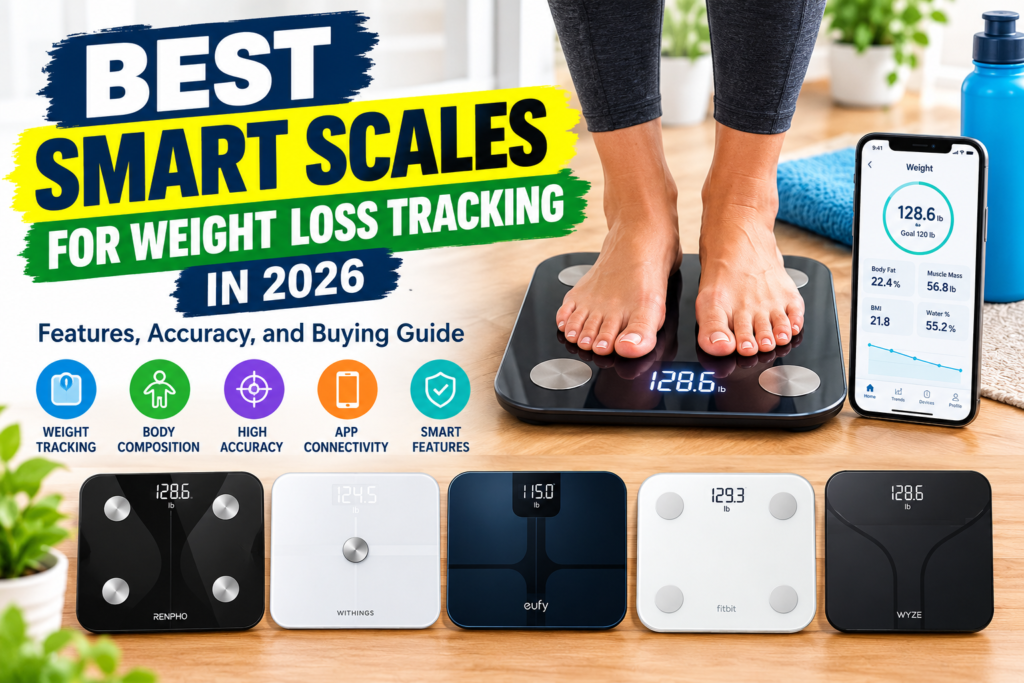
Compare the best smart scales for weight loss tracking in 2026. Explore features, body-fat accuracy, app connectivity, and tips for choosing the right scale.
LifeCareBalance.com is reader-supported. When you buy through links on our site, we may earn an affiliate commission at no extra cost to you. As an Amazon Associate, we earn from qualifying purchases.
Tracking weight loss is easier when you can see consistent measurements over time. A smart scale can help by recording body weight, syncing readings to a smartphone, and displaying trends that may be difficult to notice from occasional weigh-ins.
However, not every smart scale offers the same value. Some focus on dependable weight measurement and simple app syncing. Others estimate body fat, muscle mass, body water, and additional measurements. Premium models may add Wi-Fi, larger displays, or more detailed app reports.
The important question is not how many numbers a scale displays. It is whether those measurements help you make practical decisions without creating confusion.
Quick answer: For most people tracking weight loss at home, a smart scale with dependable weight measurement, easy app syncing, clear trend charts, and a suitable user profile system is a sensible choice. RENPHO and Etekcity offer budget-friendly options to investigate, while more expensive scales may appeal to people who want additional features. Treat body-fat and muscle estimates as approximate trends rather than clinical measurements.
This guide explains what to look for, how smart scales work, how to compare features, and how to use your readings more consistently.
Smart Scales for Weight Loss: What Actually Matters?
A smart scale is a digital weighing scale that can send measurements to a connected app or online account. Depending on the model, it may record body weight alone or estimate additional body-composition measurements.
For weight management, the most useful features are often straightforward:
- Consistent body-weight readings.
- A clear history of measurements.
- Easy-to-read weekly and monthly trends.
- Reliable app connectivity.
- A suitable maximum weight capacity.
- A user interface you can understand.
- A reasonable purchase price without unnecessary subscription costs.
Additional measurements can be interesting, but they should not automatically determine which scale you buy.
For example, a device that reports dozens of body metrics is not necessarily more useful for weight loss than a simpler scale with a reliable app and readable trend charts.
The best choice depends on your needs, budget, and willingness to use the app regularly.
Quick Comparison: Which Type of Smart Scale Should You Choose?
| Scale type | Best for | Main advantage | Main limitation |
|---|---|---|---|
| Basic digital scale | People tracking weight only | Simple operation | No automatic app history |
| Bluetooth smart scale | Budget-conscious users | App syncing at a lower cost | Usually needs a nearby phone |
| Wi-Fi smart scale | People who want automatic syncing | Measurements can sync through home Wi-Fi | Often costs more |
| Body-composition scale | Users interested in estimated body-fat trends | Adds measurements beyond weight | Estimates can differ from reference methods |
| Premium connected scale | Users who value extensive app features | More detailed reports and integrations | Higher price may not deliver meaningful extra value |
For many buyers, a Bluetooth smart scale is sufficient. Wi-Fi is worth considering if you want readings to sync without opening an app near the scale.
Recommended Smart Scales to Consider in 2026
The products below represent different priorities. Confirm the current US listing, exact model, included features, price, and availability before buying because Amazon listings and product variants can change.
1. RENPHO Smart Body Fat Scale — Budget-Friendly Tracking
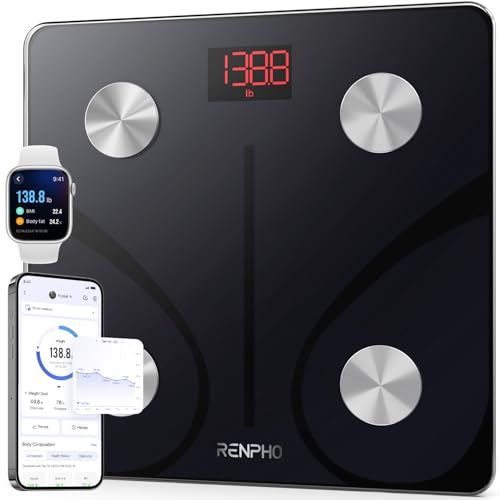
- Smart App Sync & Fitness Integration: Easily connect your digital scale for body weight to the RENPHO Health app via Blu…
- Track Progress & Stay Motivated: In addition to 3 metrics displayed—weight, BMI, and body fat—this bathroom scale also m…
- Getting into the Habit of Health with RENPHO Smart Scale: Serving as your personal health manager, the RENPHO Health app…
Best for: Buyers who want affordable weight tracking with app-based body-composition estimates.
RENPHO’s smart-scale range is designed for home users who want to record measurements through a smartphone app rather than maintain a manual log. Depending on the exact model, features can include weight, BMI, body-fat estimates, and other calculated metrics.
Its main attraction is the combination of a relatively accessible price and app-based tracking. This can be useful if your goal is to review your weight trend over several weeks rather than focus on one daily reading.
Before purchasing, check the exact model name. RENPHO sells multiple scales, and their connectivity, displays, electrode arrangements, and supported metrics may differ.
What to check before buying
- Whether the listing is for the RENPHO model you want.
- Which health and fitness apps it supports.
- Whether the scale uses Bluetooth or Wi-Fi.
- How many user profiles it supports.
- Its maximum weight capacity.
- Whether any desired features require an account or paid service.
Limitation: The app’s body-fat percentage is an estimate, not a direct measurement of fat mass. Do not assume that a long list of calculated metrics makes this scale clinically accurate.
Amazon US ASIN to check: B01N1UX8RW — RENPHO Smart Scale listing. Confirm that the live Amazon page still matches the intended model before adding your affiliate link.
2. Etekcity Smart Scale — A Practical Everyday Option

- 𝑼𝒏𝒑𝒂𝒓𝒂𝒍𝒍𝒆𝒍𝒆𝒅 𝑨𝒑𝒑 𝑬𝒙𝒑𝒆𝒓𝒊𝒆𝒏𝒄𝒆: Elevate your fitness journey with us. Our scale stands out with the free vesync app, offeri…
- 𝑼𝒑𝒈𝒓𝒂𝒅𝒆 𝑷𝒓𝒆𝒄𝒊𝒔𝒊𝒐𝒏: Benefit from our 10 years of professional experience and join over 5 million satisfied customers acro…
- 𝑽𝒆𝒓𝒔𝒂𝒕𝒊𝒍𝒆 𝑾𝒆𝒊𝒈𝒉𝒊𝒏𝒈 𝑺𝒐𝒍𝒖𝒕𝒊𝒐𝒏: Our scale offers 3 different modes designed to cater to all your needs. Zero-Current Mode e…
Best for: Users who want digital weight tracking and additional measurements through a connected app.
Etekcity offers connected body-weight scales that combine a digital platform with app-based tracking. Depending on the model, the app may report body-fat estimates, BMI, muscle-related estimates, and other calculated measurements.
The brand is worth considering if you want to compare affordable options before spending more on a premium scale.
Do not assume every Etekcity model has the same display, connectivity, app features, or body-composition capabilities. Check the exact model number and product description.
What to check before buying
- Whether the product listing includes the features you need.
- Compatibility with your phone and preferred health app.
- Whether measurements sync automatically or require the app to be opened.
- The number of supported users.
- Battery type and replacement requirements.
- Return policy and manufacturer support.
Limitation: A smart scale can provide a useful weight history, but its body-composition estimates may differ from other devices and reference methods. Use the same device under similar conditions when reviewing trends.
Amazon US ASIN to check: B095YJW56C — Etekcity smart body-weight scale listing. Verify the current listing’s model and specifications before publishing a product link.
Should You Pay More for a Premium Smart Scale?
A premium scale may offer Wi-Fi, a larger display, a broader range of measurements, or integration with a health platform. Those features can be convenient, particularly for households that want automatic syncing or a more detailed dashboard.
But a higher price does not guarantee that its body-fat estimate will be correct for every individual.
Before upgrading, ask yourself three questions:
- Will the additional features change how I manage my weight?
- Does the app provide useful information that I cannot already get from a simpler model?
- Is the extra cost justified by convenience, compatibility, or a feature I genuinely need?
If you mainly want to track weight over time, a simpler scale may be enough.
How Smart Scales Measure Body Fat
Many smart scales use bioelectrical impedance analysis, commonly called BIA.
BIA sends a very small electrical current through the body and measures impedance. Because tissues differ in their electrical properties, the device combines the impedance measurement with information such as height, weight, age, and sex to estimate body composition.
The scale does not directly see or count fat cells. Its software uses a prediction equation to estimate values such as body-fat percentage, muscle mass, or body water.
This distinction is essential when interpreting the numbers.
Research comparing consumer smart scales with DXA found that weight measurements were generally more dependable than body-composition estimates. The researchers concluded that the tested smart scales should not replace DXA for clinical body-composition assessment.
Read the study: https://pmc.ncbi.nlm.nih.gov/articles/PMC8122302/
Why Body-Fat Readings Can Differ
A body-fat reading may vary because of:
- Hydration and fluid balance.
- Recent food and drink intake.
- Exercise before measurement.
- Time of day.
- Differences in device design.
- The manufacturer’s prediction equation.
- Differences between your body and the population used to develop the equation.
These factors help explain why two smart scales can show different body-fat percentages for the same person.
A more expensive device or a scale advertising additional frequencies may have useful technical features, but that alone does not establish that its results are the most accurate for every user.
For a deeper explanation of BIA, measurement limitations, and reference methods, read our smart scale body-fat accuracy guide.
Smart Scale Accuracy: Weight vs. Body Composition
Not all scale measurements should be interpreted in the same way.
Body weight: A properly used digital scale can be useful for tracking weight changes over time.
BMI: BMI is calculated from weight and height. It is a screening measure, not a direct measurement of body fat or a complete assessment of health.
Body-fat percentage: On most consumer smart scales, this is an estimate generated using BIA and a prediction equation.
Muscle mass: This is usually a calculated estimate. It should not be treated as a direct measurement of muscle tissue.
Body water: This is also estimated and may be affected by hydration and other conditions.
Visceral fat: When a scale displays a visceral-fat score, it generally provides an estimate based on its algorithm. It does not directly image or measure abdominal organs or the fat surrounding them.
A useful rule is to give more weight to consistent trends than to a single body-composition number.
What Does Research Say About Accuracy?
Studies comparing consumer BIA devices with reference methods have found that the degree of agreement varies by device and measurement. A device can correlate reasonably well with a reference method across a group while still producing a meaningful difference for an individual.
That means two statements can both be true:
- Smart scales can be useful for tracking measurements at home.
- Their body-composition estimates should not be treated as exact clinical results.
The evidence does not support declaring one consumer scale universally the most accurate without a well-designed, model-specific comparison.
Research reference: https://pubmed.ncbi.nlm.nih.gov/20054195/
Bluetooth vs. Wi-Fi Smart Scales
Connectivity is one of the most practical differences between smart scales.
Bluetooth scales
Bluetooth scales typically send readings to a phone when it is nearby and connected. This can keep the purchase price lower.
Choose Bluetooth if you normally weigh yourself with your phone close by and do not mind opening the app when necessary.
Wi-Fi scales
Wi-Fi scales can transmit measurements through your home network. Depending on the product, readings may appear in your account without requiring your phone to be nearby.
This can be useful for households with multiple users or people who prefer automatic syncing.
Which is better?
Neither connection type automatically makes body-composition readings more accurate.
Choose Wi-Fi for convenience if the additional cost is worthwhile. Choose Bluetooth if you want basic connected tracking at a lower price.
Also check whether the scale supports Apple Health, Android health platforms, or any specific fitness app you already use. Compatibility varies by manufacturer and model.
How to Choose the Right Smart Scale
1. Start with your main goal
If your main goal is monitoring weight loss, prioritize dependable weight readings and trend history.
If you want to observe estimated body-composition changes, a BIA model may provide additional context—but remember its limitations.
If several people will share the scale, look for clear user-profile management and reliable user recognition.
2. Check the maximum weight capacity
Confirm the scale’s stated maximum capacity before purchasing. Do not assume every model supports the same maximum weight.
Use the scale on the type of floor recommended by the manufacturer and follow its setup instructions.
3. Review app compatibility
A scale is less useful if its app does not work well with your phone or preferred health platform.
Check the current app requirements, permissions, syncing method, account requirements, and supported integrations before ordering.
4. Consider subscription costs
Some connected products may offer optional paid services or premium insights. Check which features are available without a subscription and whether recurring charges are required for anything you consider essential.
A subscription is not automatically bad value, but it should be part of the purchase decision.
5. Look for a useful measurement history
Trend charts should make it easy to compare measurements across days and weeks.
A good app should help you understand changes without encouraging you to treat every daily fluctuation as meaningful.
6. Read the product specifications carefully
Check the exact model, platform dimensions, display, battery type, connectivity, included accessories, warranty, and return policy.
Manufacturer specifications establish what the product claims to offer; they do not, by themselves, prove independent accuracy.
7. Consider the household
If several people will use the scale, investigate supported profiles and how the device assigns readings. Automatic user recognition can be convenient, but check whether users can correct a misassigned measurement.
For a more focused product comparison, see our Withings vs. Eufy smart scale comparison.
How to Use a Smart Scale More Consistently
The way you use a scale can affect the usefulness of your trend data.
For a consistent routine:
- Place the scale on a firm, level surface.
- Follow the manufacturer’s instructions for setup and measurement.
- Weigh yourself at a similar time of day.
- If practical, measure after using the bathroom and before eating or drinking.
- Use the same scale and app.
- Avoid comparing readings taken under very different conditions.
- Review weekly or longer-term trends rather than reacting to one reading.
Weight can change from day to day because of fluid balance, digestion, recent meals, exercise, and other ordinary factors. A short-term increase does not automatically mean body fat has increased, just as a short-term decrease does not prove fat loss.
Should You Weigh Yourself Every Day?
Some people find regular weighing useful, while others find frequent measurements stressful or unhelpful.
You do not need to weigh yourself every day to make progress. A schedule you can maintain without anxiety is more useful than one that makes you feel compelled to check the scale repeatedly.
If frequent weighing affects your mood, leads to restrictive behavior, or becomes distressing, consider reducing the frequency and discussing your concerns with a qualified healthcare professional.
Smart Scales and Weight-Loss Progress
A scale can be one tool in a broader weight-management routine, but it cannot explain every change in your body.
Weight trends are more informative when considered alongside sustainable eating habits, regular movement, sleep, and other factors relevant to your goals.
For example, someone beginning strength training may experience changes in body composition while body weight changes slowly. A smart scale’s estimated muscle and fat readings may provide additional context, but they should not be treated as definitive proof of what changed.
You can also use a simple log to record measurements, activity, and other habits you want to monitor.
For practical ideas about movement and home fitness, explore our fitness and movement products guide.
For a broader approach to building habits that fit your life, see our personalized wellness guide.
Do You Need a Smart Scale to Lose Weight?
No. A standard digital scale—or another tracking method recommended by your healthcare professional—may be enough.
The value of a smart scale comes from convenience and the ability to review historical data. It does not cause weight loss by itself, and its additional measurements are not necessary for everyone.
Buy one if its features solve a practical problem. Do not feel pressured to buy a premium model simply because it reports more metrics.
Safety and Medical Limitations
Smart scales are consumer devices, not substitutes for medical assessment.
People who are pregnant, have an implanted electronic medical device, or have a condition that affects fluid balance should check the specific manufacturer’s safety guidance before using a scale’s BIA function. Do not assume that the same precautions or special modes apply to every model.
If you have a medical condition or need accurate body-composition measurements for treatment, ask your healthcare professional which measurement method is appropriate.
A smart scale should not be used to diagnose a medical condition, assess cardiovascular health, or make treatment decisions from a single reading.
Frequently Asked Questions
What is the best smart scale for weight loss tracking in 2026?
The best choice depends on your budget and needs. A budget-friendly model with dependable weight tracking and a useful app may be sufficient for most people. Compare the exact model, connectivity, app compatibility, and user-profile features before buying.
Are smart scales accurate for body fat?
Smart scales generally provide estimates of body fat through bioelectrical impedance analysis. Results can differ from reference methods such as DXA, so body-fat readings should be treated as approximate rather than exact.
Is a Wi-Fi smart scale better than Bluetooth?
Wi-Fi can make automatic syncing more convenient, while Bluetooth models are often less expensive. Connectivity does not automatically determine measurement accuracy.
Can a smart scale measure visceral fat accurately?
Consumer scales generally estimate visceral fat using a manufacturer’s algorithm. They do not directly image or measure visceral fat, so the displayed value should not be interpreted as a clinical measurement.
Should I buy a scale that measures muscle mass?
Only if the extra estimate is useful to you. Remember that muscle-related readings on consumer scales are usually calculated estimates. They are not a direct measurement of muscle tissue.
Why does my body-fat percentage change from one day to the next?
Hydration, exercise, food intake, measurement timing, and other conditions can affect BIA estimates. Measure under similar conditions and focus on longer-term patterns.
Can a smart scale replace a DEXA scan?
No. Consumer smart scales should not be treated as replacements for DXA when a clinician needs a reference assessment of body composition.
Do smart scales work without a phone?
It depends on the model. Some show weight directly on the scale but require a phone for app syncing or additional metrics. Others offer more information on the device’s own display. Check the exact product specifications.
Are smart scales worth the money?
They can be worthwhile if automatic tracking, trend charts, or app integrations help you maintain a consistent routine. If you only need body weight, a standard digital scale may be sufficient.
Final Verdict
For weight loss tracking, prioritize consistency, usability, and a clear measurement history over the number of metrics advertised on the box.
RENPHO and Etekcity offer budget-friendly smart-scale options worth comparing, but check the exact US listing and features before buying. A premium model may offer more convenience, but a higher price does not guarantee that its body-fat estimates will be more accurate for every individual.
Use smart-scale data as one part of a broader routine. Track measurements consistently, interpret body-composition estimates cautiously, and seek professional advice when you need medical assessment.
The best scale is the one that fits your needs, produces useful trend data, and helps you make informed decisions without turning everyday fluctuations into unnecessary worry.
Affiliate disclosure: LifeCareBalance is reader-supported. As an Amazon Associate, we may earn from qualifying purchases at no additional cost to you. Product availability, prices, specifications, and seller terms can change; check the current listing before purchasing.
Medical disclaimer: This article is for general educational purposes only and is not a substitute for professional medical advice, diagnosis, or treatment.