
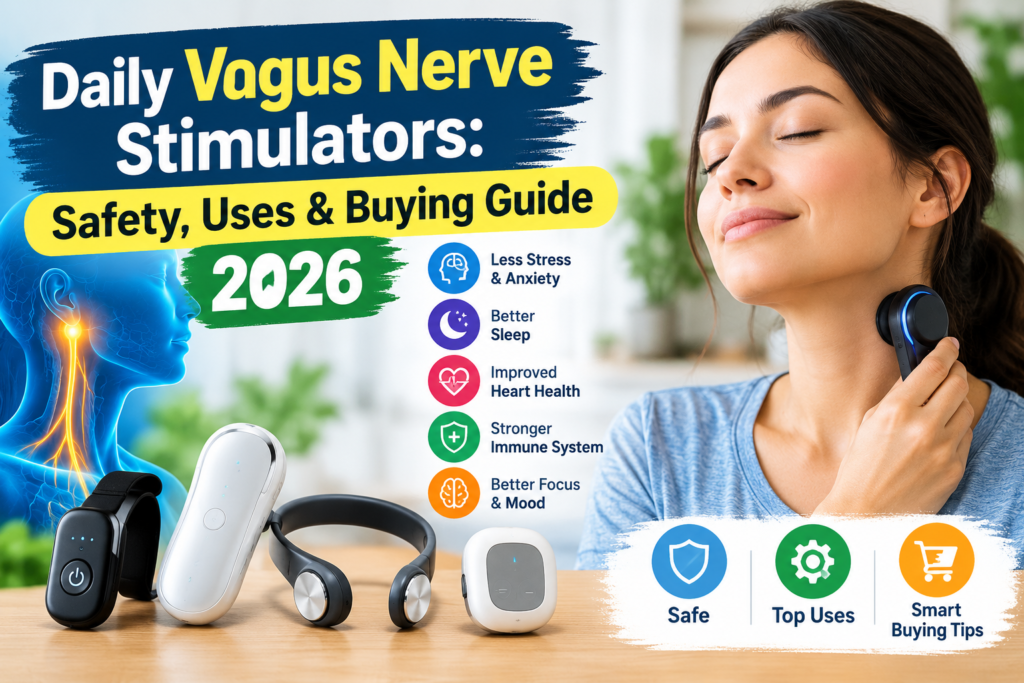
Learn how daily vagus nerve stimulators work, what research shows, safety considerations, device types, and what to look for before buying.
LifeCareBalance.com is reader-supported. When you buy through links on our site, we may earn an affiliate commission at no extra cost to you. As an Amazon Associate, we earn from qualifying purchases.
Vagus nerve stimulation has become an increasingly popular topic in the wellness and neuromodulation space. People searching for daily vagus nerve stimulators are often interested in relaxation, stress management, sleep routines, or learning more about non-invasive stimulation technology.
But there is an important distinction that shoppers should understand before buying a device: not every product marketed as a vagus nerve stimulator has the same technology, intended use, evidence, or regulatory status.
Medical VNS, non-invasive VNS, transcutaneous auricular VNS (taVNS), and consumer wellness devices can be very different.
The research surrounding non-invasive vagus nerve stimulation is developing, and some studies have reported encouraging findings. At the same time, researchers continue to identify differences in stimulation parameters, treatment protocols, device designs, and clinical outcomes.
This guide explains what daily vagus nerve stimulators are, how they differ from medical VNS, what current research says about safety, how to choose a device, and what to consider before incorporating one into a regular wellness routine.
Important: This article is for general educational purposes and is not medical advice. Electrical nerve-stimulation devices may not be appropriate for everyone. If you have a medical condition, implanted electronic device, heart-rhythm concern, neurological condition, or another health concern, speak with a qualified healthcare professional before using a stimulation device.
What Is a Vagus Nerve Stimulator?
A vagus nerve stimulator is a device designed to deliver stimulation intended to influence the vagus nerve or related neural pathways.
The vagus nerve is a major nerve connecting the brain with parts of the body including the neck, chest, and abdomen. It is involved in autonomic functions and communication between the brain and internal organs.
There are several forms of vagus nerve stimulation.
Implanted Vagus Nerve Stimulation
Traditional medical VNS involves a surgically implanted pulse generator connected to the vagus nerve.
This type of treatment is used for specific medical indications and requires medical supervision.
MedlinePlus explains that implanted VNS uses a pulse generator and electrode connected to the left vagus nerve. It is fundamentally different from a consumer wellness device that sits on the skin.
Non-Invasive Vagus Nerve Stimulation
Non-invasive VNS, often called nVNS or tVNS depending on the method, delivers stimulation through the skin without surgical implantation.
Some devices are designed for the neck, while others use stimulation around the ear.
The FDA maintains specific classifications for non-invasive vagus nerve stimulators, including devices intended for headache-related indications.
Transcutaneous Auricular VNS
Transcutaneous auricular vagus nerve stimulation, or taVNS, uses stimulation around parts of the outer ear.
Researchers have studied this approach in several areas, including sleep, neurological rehabilitation, autonomic function, and mental-health-related research.
A 2025 review of taVNS research found that safety was generally favorable, but also emphasized substantial variability in stimulation parameters and the need for further validation of optimal protocols.
Why Are People Interested in Daily Vagus Nerve Stimulators?
The biggest attraction is convenience.
People may want a device that can fit into a short daily routine rather than requiring a clinical visit.
Common reasons consumers explore these devices include:
- Relaxation
- Stress-management routines
- Evening wind-down
- Meditation
- General wellness
- Interest in nervous-system technology
- Sleep-related wellness
- Non-invasive neuromodulation
However, it is important not to confuse consumer interest with proven medical effectiveness.
A study involving one specific stimulation method does not automatically prove that every consumer device produces the same result.
The device, electrode placement, stimulation intensity, frequency, duration, and intended use can all matter.
How Does Vagus Nerve Stimulation Work?
The vagus nerve is part of a large communication network between the brain and body.
Non-invasive VNS attempts to influence this system through controlled stimulation.
The exact biological mechanisms can vary depending on the stimulation approach.
For example, an ear-based device and a neck-based device do not necessarily stimulate the same anatomical area in the same way.
Research has investigated changes in autonomic nervous-system activity and other physiological or neurological responses, but researchers continue to study which stimulation parameters are most effective for specific goals.
This is why shoppers should avoid products making extremely broad claims such as “one device treats everything.”
Are Daily Vagus Nerve Stimulators Safe?
Safety is one of the most important considerations.
The available research on non-invasive taVNS is generally encouraging from a tolerability perspective, but “generally well tolerated” does not mean that every device is appropriate for every person.
A systematic review and meta-analysis evaluated 177 studies involving 6,322 participants. The review found that reported adverse effects were generally mild, although not all studies reported adverse events consistently.
A more recent 2025 review also reported relatively high safety across the studies it evaluated while emphasizing that stimulation parameters vary significantly between studies.
For consumers, the practical lesson is:
Safety depends on the exact device, how it is used, and the individual using it.
Possible Side Effects
Non-invasive stimulation can sometimes cause temporary discomfort.
Reported effects may include:
- Tingling
- Localized discomfort
- Skin irritation
- Headache
- Ear discomfort with auricular stimulation
- Dizziness
- Temporary sensitivity around the stimulation area
The systematic review of taVNS found that adverse events were generally mild in the available research.
If a device causes significant pain, unusual symptoms, or persistent irritation, stop using it and seek appropriate medical advice.
Do not assume that stronger stimulation is better.
Can You Use a Vagus Nerve Stimulator Every Day?
There is no universal daily schedule that applies to every VNS device.
Different products can have different:
- Stimulation strengths
- Frequencies
- Electrode designs
- Placement requirements
- Session durations
- Recommended schedules
- Intended uses
Therefore, the safest approach is to follow the instructions supplied with the exact device.
Do not copy the settings or schedule from another product simply because both devices are marketed as “vagus nerve stimulators.”
Research protocols should also not automatically be treated as consumer-use instructions.
Daily VNS vs. General Stress Relief
Many people searching for vagus nerve stimulation are actually looking for a convenient stress-relief tool.
That means a VNS device may be considered alongside other relaxation strategies rather than replacing them.
Useful wellness habits can include:
- Slow breathing
- Meditation
- Regular exercise
- Consistent sleep
- Short movement breaks
- Reduced evening screen exposure
- Relaxing music
- Massage or recovery tools
For readers who are primarily looking for non-electrical relaxation products, see our verified LifeCareBalance guide:
Best Stress Relief Products That Help You Relax Instantly
The important point is that VNS is one possible tool, not a requirement for managing everyday stress.
What Does Current Research Say About Vagus Nerve Stimulation?
Research into non-invasive VNS continues to expand.
Studies have examined possible applications involving:
- Sleep
- Anxiety-related symptoms
- Depression-related symptoms
- Neurological rehabilitation
- Stroke rehabilitation
- Autonomic nervous-system activity
- Pain
- Cognitive function
A 2025 review covering healthy individuals, stroke, and Parkinson’s disease found that taVNS was generally well tolerated, while also emphasizing that effects can depend on stimulation parameters and that further evidence is needed.
A newer 2026 systematic review and meta-analysis examined taVNS for sleep disorders. It found improvements in several sleep-related outcomes and reported a generally favorable safety profile, but the authors also emphasized study heterogeneity and the need for larger, better-designed trials.
That distinction is critical for consumers.
Promising research does not mean that every consumer VNS product has been proven to produce the same outcomes.
Vagus Nerve Stimulation and Sleep
Sleep is one of the areas receiving increasing research attention.
The 2026 systematic review and meta-analysis included 14 randomized controlled trials and found improvements in sleep quality and sleep-onset measures, along with reductions in some anxiety- and depression-related scores. However, the authors described the evidence as preliminary because of heterogeneity between studies and limitations in clinical interpretation.
Therefore, it would be inappropriate to describe a consumer VNS device as a guaranteed insomnia treatment.
Instead, consumers should think of stimulation as a potential wellness tool while maintaining the fundamentals of good sleep:
- Consistent bedtime
- Adequate sleep duration
- Comfortable sleep environment
- Reduced late-night stimulation
- Regular physical activity
- Appropriate medical evaluation when sleep problems persist
If you are specifically interested in technology that tracks sleep rather than electrically stimulating nerves, see our:
Sleep Tracker Buying Guide 2026
A sleep tracker and a VNS device perform completely different functions.
A sleep tracker estimates physiological and movement signals.
A VNS device actively delivers stimulation.
What Is the Difference Between Medical VNS and Consumer Devices?
This is one of the most important buying distinctions.
| Feature | Medical VNS | Non-Invasive / Consumer Device |
|---|---|---|
| Implantation | Some systems are implanted | External |
| Medical supervision | Required for medical treatment | Depends on device |
| Intended use | Specific medical indications | May be medical or wellness-oriented |
| Stimulation | Device-specific | Device-specific |
| Regulatory status | Exact device dependent | Exact device dependent |
| Research | Often indication-specific | Varies significantly |
| Daily schedule | Clinician-directed when medically indicated | Follow manufacturer instructions |
The National Institute of Mental Health explains that traditional VNS involves an implanted device, while non-invasive VNS uses an external device and remains an area of ongoing research for many applications.
This is why consumers should not assume that a product sold online under the VNS label has the same clinical status as an implanted medical VNS system.
What Types of Non-Invasive VNS Devices Are Available?
1. Ear-Based VNS Devices
Ear-based products use electrodes or clips around parts of the outer ear.
Potential advantages include:
- Compact size
- Portability
- No surgical implantation
- Short sessions
- Easy integration into a routine
However, comfort and correct placement are important.
2. Neck-Based VNS Devices
Neck-based devices apply stimulation around the side of the neck.
The FDA has classifications for specific non-invasive vagus nerve stimulators intended for headache-related indications.
That does not mean every neck device sold online has the same regulatory status.
Always check the exact product.
3. Handheld Wellness Devices
Some consumer products are designed as handheld stimulation or relaxation devices.
These products may be marketed primarily for general wellness.
The buyer should examine the manufacturer’s intended-use statement and safety instructions rather than relying only on the product name.
4. TENS-Based Products
Some websites suggest adapting TENS devices for vagus nerve stimulation.
This requires caution.
A generic TENS device is not automatically equivalent to a dedicated VNS device.
The intended target, electrode placement, stimulation parameters, and evidence may be completely different.
For this reason, buyers should not purchase a generic electrical stimulator simply because a product listing uses the words “nerve stimulation.”
How to Choose a Daily Vagus Nerve Stimulator
If you are considering purchasing a device, focus on evidence, usability, and safety rather than marketing language.
1. Check the Intended Use
A reputable product should clearly explain what it is designed to do.
Be cautious about products claiming to treat a very long list of unrelated conditions.
2. Check Stimulation Instructions
Look for clear information about:
- Placement
- Session duration
- Intensity
- Frequency of use
- Contraindications
- Cleaning and maintenance
3. Look for Adjustable Intensity
Adjustable stimulation can make it easier to follow the manufacturer’s recommended progression.
A beginner should not assume that maximum intensity is appropriate.
4. Consider Comfort
For daily use, comfort matters.
An uncomfortable device is unlikely to become a sustainable part of your routine.
5. Check the Evidence
Look for evidence related to the actual device or stimulation method.
A company should not imply that research on an unrelated VNS system proves the effectiveness of its own product.
6. Review Safety Information
A product should clearly explain when it should not be used and when a healthcare professional should be consulted.
7. Check Warranty and Support
A clear warranty and accessible customer support can matter more than a long list of unnecessary features.
What About Budget Vagus Nerve Stimulators?
Price does not automatically tell you whether a device is good or bad.
A budget device may provide a simple design and basic controls.
A more expensive product may include:
- App connectivity
- Rechargeable hardware
- Multiple programs
- More advanced controls
- Better industrial design
- Customer support
- Additional accessories
However, a higher price does not automatically mean stronger clinical evidence.
For readers specifically comparing lower-cost options, our related guide is:
Budget-Friendly Vagus Nerve Stimulators Under $200
Use that guide as a starting point, but verify the current product, price, specifications, and intended use before purchasing.
What Should You Avoid When Buying One?
Avoid exaggerated medical claims
Be cautious when a product claims to treat numerous conditions without strong evidence.
Avoid anonymous products
If there is no clear manufacturer, safety documentation, or customer support, think twice.
Avoid copying settings
Never assume that another product’s intensity or session duration is appropriate.
Avoid maximum intensity
More stimulation is not automatically better.
Avoid confusing TENS with VNS
A TENS device and a dedicated VNS device should not automatically be treated as interchangeable.
Avoid replacing medical treatment
A consumer wellness device should never be used as a replacement for prescribed treatment.
Who Should Be More Careful With VNS Devices?
Extra caution is appropriate for people with:
- Implanted electronic devices
- Significant heart conditions
- Abnormal heart rhythms
- Neurological conditions
- Relevant neck or nerve surgery
- Pregnancy
- Complex medical conditions
- Ongoing medical treatment
This does not mean every person in these categories is automatically prohibited from using every type of stimulation.
It means the decision should be discussed with an appropriate healthcare professional rather than based solely on an online product listing.
MedlinePlus notes that VNS is not appropriate for everyone and describes several medical situations requiring caution or avoidance.
What Does FDA Status Actually Mean?
This is an area where affiliate websites often make mistakes.
There is no single FDA status for every product described as a “vagus nerve stimulator.”
The FDA database includes specific classifications for non-invasive VNS devices intended for particular uses. For example, one classification describes an external vagal nerve stimulator for headache and identifies it as a Class II medical device.
That does not mean every consumer VNS product is FDA approved for every claim made in its marketing.
The exact device and intended use matter.
Also remember the distinction between:
- FDA approved
- FDA cleared
- FDA classified
- General wellness product
- Research device
These terms should not be used interchangeably.
NIMH also explains the distinction between FDA approval and clearance for medical devices.
Can VNS Replace Meditation or Breathing Exercises?
No.
A stimulation device and a behavioral relaxation technique are different tools.
Slow breathing, meditation, physical activity, and healthy sleep habits remain useful parts of a wellness routine.
Some users may choose to combine these habits with a device session.
For example, a person might use a manufacturer-recommended stimulation session and then spend five minutes doing slow breathing.
The goal should be to create a sustainable routine rather than continuously adding more gadgets.
Can You Use VNS Before Bed?
Some people choose to use non-invasive stimulation as part of an evening wind-down routine.
Research into taVNS and sleep is developing, and the 2026 meta-analysis reported promising findings while still emphasizing that additional research is needed.
If you use a device before bed:
- Follow the manufacturer’s instructions
- Use the recommended intensity
- Do not extend sessions simply because you want a stronger effect
- Stop if the device causes discomfort
- Avoid treating the device as a substitute for sleep hygiene
If you have persistent insomnia or other sleep symptoms, discuss them with a healthcare professional.
How Sleep Tracking Can Complement a Wellness Routine
VNS and sleep tracking can be thought of as two different categories of technology.
A stimulation device delivers an intervention.
A sleep tracker collects and estimates information.
If you use wearable technology, focus on trends rather than becoming obsessed with individual nightly scores.
Our related guide explains how sleep duration, HRV, resting heart rate, sleep stages, and recovery trends can be interpreted:
How Sleep Tracking Can Improve Recovery in 2026
This distinction is particularly important because consumer sleep trackers are estimates rather than clinical diagnostic tools.
Building a Practical Daily Wellness Routine
A VNS device should fit into your lifestyle rather than dominate it.
A simple routine might include:
Morning
- Hydration
- Light movement
- Outdoor light exposure
- Regular breakfast if appropriate
- Optional device session according to manufacturer instructions
During the Workday
- Short movement breaks
- Breathing exercises
- Reduced prolonged sitting
- Stress-management strategies
Evening
- Lower screen stimulation
- Relaxing activities
- Consistent bedtime
- Meditation or slow breathing
- Optional stimulation session if appropriate for the device
The goal is consistency.
A simple two-minute routine you actually follow may be more valuable than a complicated routine requiring several devices.
Common Mistakes People Make
Mistake 1: Assuming Every VNS Device Is the Same
Different devices can use completely different stimulation methods.
Mistake 2: Treating Research as Proof of Every Product Claim
Research on taVNS does not automatically prove that every consumer device produces the same results.
Mistake 3: Confusing Medical VNS With Wellness Devices
Implanted VNS and consumer non-invasive products can have very different purposes and regulatory statuses.
Mistake 4: Believing Stronger Is Better
Higher intensity is not automatically more effective.
Mistake 5: Ignoring the Manufacturer’s Instructions
Placement and session duration can matter.
Mistake 6: Buying Only Because of Influencer Marketing
A social-media recommendation is not the same thing as clinical evidence.
Mistake 7: Expecting a Device to Fix Poor Lifestyle Habits
No stimulation device can replace adequate sleep, physical activity, stress management, and appropriate medical care.
Are Daily Vagus Nerve Stimulators Worth Buying?
They may be worth considering for people specifically interested in non-invasive neuromodulation and technology-assisted wellness routines.
They may make sense if:
- You understand what the device is designed to do
- You have realistic expectations
- You are comfortable following instructions
- You prefer technology-based wellness tools
- The product provides clear safety information
- The price fits your budget
They may not be worth buying if:
- You expect guaranteed medical results
- You want to replace professional treatment
- The product makes unrealistic health claims
- The manufacturer provides little safety information
- You are unsure whether electrical stimulation is appropriate for you
How VNS Fits Into the Broader Wellness Market
Vagus nerve stimulation is only one part of the rapidly expanding wellness-technology market.
Other categories include:
- Sleep trackers
- Smart rings
- Massage devices
- Recovery boots
- Red-light therapy
- Meditation tools
- Stress-relief products
- Fitness trackers
For a broader overview of consumer wellness technology, see:
Best Wellness Products for 2026: Top Picks for Health, Fitness, Sleep, Recovery, and Self-Care
The key is to choose products based on a specific problem or goal instead of buying every new wellness gadget.
Final Buying Checklist
Before purchasing a daily vagus nerve stimulator, ask:
- What exactly is this device designed to do?
- Where does it deliver stimulation?
- What does the manufacturer recommend for session length?
- What intensity levels are available?
- What safety warnings are provided?
- Is the device medical or wellness-oriented?
- What evidence exists for the specific technology?
- Does the manufacturer provide customer support?
- What is the warranty?
- Are replacement parts required?
- Does the product make claims that seem too broad?
- Is it appropriate for my personal situation?
- Have I checked the current product specifications and price?
If you cannot answer these questions, you probably need more information before buying.
Final Thoughts
Daily vagus nerve stimulators are an interesting category within modern wellness technology and non-invasive neuromodulation.
The research is active, and studies of taVNS have generally reported favorable tolerability while continuing to investigate effectiveness for specific applications.
At the same time, consumers should avoid treating all VNS products as identical.
The most important differences include:
- Stimulation location
- Electrical parameters
- Intended use
- Manufacturer instructions
- Regulatory status
- Evidence
- Safety information
The best approach is therefore not to choose the product with the biggest list of health claims.
Instead, choose based on clear intended use, transparent safety information, appropriate evidence, comfortable design, realistic expectations, and reliable manufacturer support.
If your primary goal is relaxation, a VNS device can be considered as one part of a broader routine that also includes sleep, exercise, breathing, stress management, and healthy daily habits.
Most importantly, remember that a consumer wellness product is not automatically equivalent to a medical VNS system.
Frequently Asked Questions
Are daily vagus nerve stimulators safe?
Research on non-invasive taVNS generally suggests favorable tolerability, with reported adverse effects often being mild. However, safety depends on the exact device, stimulation parameters, and individual user.
Can I use a vagus nerve stimulator every day?
Some devices are designed for repeated use, but there is no universal daily schedule. Follow the instructions provided for your exact device.
Can vagus nerve stimulation help with stress?
VNS is being studied for effects involving autonomic and neurological function, but evidence varies by stimulation method and application. A consumer device should not be presented as a guaranteed treatment for anxiety or other medical conditions.
Can VNS improve sleep?
Research is promising. A 2026 systematic review found improvements in several sleep-related outcomes, but the researchers also noted heterogeneity and the need for larger, better-designed studies.
What is the difference between VNS and TENS?
TENS is generally designed for transcutaneous electrical nerve stimulation and is commonly associated with pain-management applications. A dedicated VNS device is specifically designed around vagus nerve stimulation. A generic TENS device should not automatically be considered equivalent to a VNS device.
Are all VNS devices FDA approved?
No. FDA status depends on the exact device and intended use. The FDA maintains specific classifications for certain non-invasive VNS devices.
Is implanted VNS the same as a consumer VNS device?
No. Implanted VNS involves a surgically implanted system used for specific medical indications. Consumer non-invasive products can have very different designs, claims, and regulatory status.
Who should speak with a doctor before using VNS?
People with implanted electronic devices, significant heart or neurological conditions, relevant surgery history, pregnancy, or other complex medical concerns should discuss the device with a qualified healthcare professional before use.
Can VNS replace medication or medical treatment?
No. A consumer VNS device should not replace prescribed medication, professional treatment, or medical evaluation.
What should I look for when buying a daily VNS device?
Look for clear intended use, transparent safety information, appropriate stimulation instructions, comfortable design, evidence relevant to the technology, warranty coverage, and reliable customer support.
What is the best time to use a VNS device?
There is no universally proven best time for every device. Follow the manufacturer’s instructions and choose a time that fits your routine safely.
Should I buy a VNS device just for better sleep?
Not necessarily. Sleep quality depends on many factors. A VNS device may be one optional wellness tool, but it should not replace good sleep habits or professional evaluation when persistent sleep problems occur.